Proposed operating model
3.7 The direct function should be led by Ministers, through the Permanent Secretary (PUS) and the Chief of the Defence Staff (CDS), supported by a smaller, integrated civilian-military Head Office. They should discharge this function primarily through a smaller Defence Board, chaired by the Defence Secretary, which focuses on taking tough prioritisation decisions. As part of the quinquennial SDSR, they should set strategic direction on the military capabilities the country needs and on the types of operations the Armed Forces should undertake, and provide the overall corporate framework.
3.8 The Royal Navy, Army, and Royal Air Force remain the fundamental building blocks of Defence. The Service Chiefs should be responsible for generating and developing their Service in line with that strategic direction and within the budget set. We believe that the Service Chiefs cannot be held wholly accountable for delivering military capability if they are not given more control over the levers they need to do so. We are therefore recommending that the Command TLBs should be made accountable, through the Chiefs, for planned and in-service equipment and support across all years within a clear control framework. This represents a significant shift. Furthermore, we recommend that the Chiefs should be given greater freedom, within this framework, to prioritise within their budgets. Each Command would balance spend between different capability areas (including between manpower, equipment and training), to propose a detailed and affordable plan which delivered the outputs required of it by Head Office. Following approval of the Command Plans they would set the equipment requirement and budget for DE&S. They would provide force elements as required to the Permanent Joint Headquarters (PJHQ).
3.9 Some enabling military capabilities are best delivered jointly. To provide a more effective vehicle for organising, commanding and championing some of these capabilities, we propose setting up a Joint Forces Command (JFC) to:
• generate and develop certain joint enabling capabilities;
• take ownership of crucial operational enablers such as Defence intelligence assets to ensure that cross-cutting capabilities are properly prioritised and resourced, alongside single Service core capabilities; and,
• champion and integrate enablers remaining within the single Services.
3.10 The Chief of Defence Materiel and DE&S would be responsible for acquiring, (procuring and supporting) equipment, systems and commodities, in line with the requirement and budget set by the three single Services and the JFC. DE&S will provide robust costing for the Commands on the equipment and support elements of their Command Plans, and confirm that they are deliverable. CDM should therefore be held to account by Command TLB customers for delivering their requirements to time and within budget, as well as quarterly by PUS for the delivery of agreed equipment and support outputs and the efficient and effective management of DE&S.
3.11 The 2nd PUS should oversee the enable function, including science and technology and the corporate enabling functions performed by the new Defence Business Services organisation (DBS) and Defence Infrastructure Organisation (DIO), which will deliver services more efficiently, more professionally and on a pan-Defence basis, rather than several times over in the TLBs.
3.12 Under the direction of Ministers and CDS, the operate function is centred on the PJHQ, which exercises operational command of forces generated by the single Services and JFC when they are deployed on joint military operations overseas. In principle, and to simplify roles, PJHQ should be responsible for all military operations. The Department should consider whether those operations not currently run by PJHQ should transfer to it. PJHQ would sit as part of the JFC, although on operational matters the Chief of Joint Operations would continue to report directly to CDS.
3.13 As departmental Accounting Officer, PUS also heads the account function, covering the full range of Defence activities and expenditure. The PUS is personally accountable to Parliament for the proper use of the resources voted to Defence, and in this task is supported by the Director General Finance and also the commercial and scrutiny functions. We recommend the Department consider whether making the CDM an Additional Accounting Officer for expenditure on equipment and support would usefully further strengthen his authority, in a way that would support, not undermine, the PUS's overall responsibility for the Department. The PUS also supports Ministers in reporting on Defence activities to Parliament, and in answering parliamentary questions, freedom of information requests, public correspondence and media enquires.
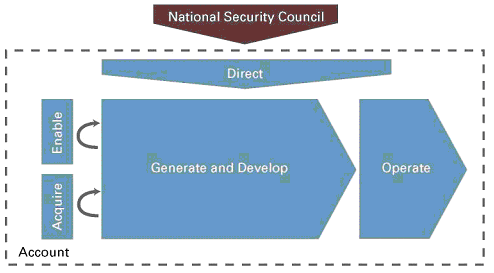
Figure 1 - Core Functions in Defence
3.14 The model depends on a strong corporate framework of financial management, performance management and people management. Financial and performance management should be strengthened throughout the Department, in terms of skills, systems and culture. A new appointments sub-committee of the Defence Board will oversee the introduction of a new career management model for very senior personnel, focused on getting the right people, with the right skills, into the key posts and keeping them there for longer. This strengthened corporate framework is a critical counterpart to the devolution of more responsibility to the TLBs. It must not translate into micro management.
3.15 The organisational framework and the key interactions between the organisations are shown in the diagram at Annex D. The responsibilities and accountabilities of the top posts are shown at Annex E.
3.16 Parts 4 to 13 provide further detail on these core judgements, the specific proposals that flow from them, and the logic behind those proposals. A full list of the recommendations is set out at Annex C.
3.17 The design of the future Defence operating model only takes the Department part of the way towards the organisation it needs. How our proposals are implemented, and how change is led will be crucial. As Annex G sets out, the Department's record on implementing major reforms is mixed; it has tended to water down recommendations, or to ignore more radical proposals. It is therefore crucial that the further work the Department must undertake to develop and implement our package of proposals is coordinated and driven from the very top. Our specific recommendations on how to ensure this happens in the way we intend are set out in Part 14 of this report.