Infrastructure Needs
The United States has underinvested significantly in transportation and other infrastructure, particularly in the past 15 years. A key source of revenue, the federal fuel tax, stands at 18.4 cents per gallon and has not increased since 1993. With decreasing growth in automobile travel and increasing fuel efficiency, the Highway Trust Fund revenues in the next federal reauthorization may necessitate a significant cut in spending.
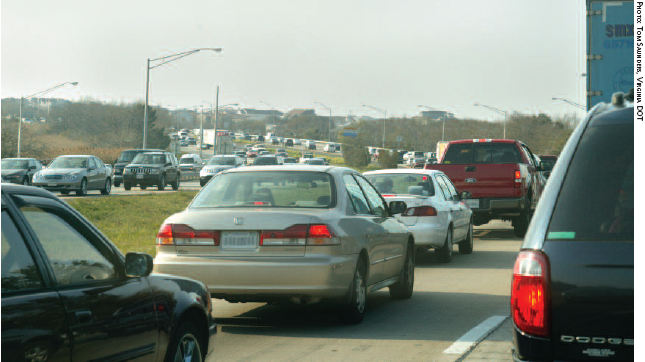
Other consequences of insufficient investment include traffic gridlock, which causes 4.2 billion hours of travel delays and wastes 2.9 billion gallons of fuel annually, according to the Texas Transportation Institute. Congestion reduces business productivity and has a negative impact on the environment. At the status quo, Americans can expect to spend the equivalent of four work weeks each year in traffic congestion by 2035, according to the American Road and Transportation Builders Association.
| Declining Highway Trust Fund revenues and underinvestment in transportation infrastructure have led to increased traffic congestion, among other consequences. |
|
The American Society of Civil Engineers reports that use of transit increased by 21 percent between 1993 and 2002-a rate faster than that of any other mode. Yet the Federal Transit Administration estimates a funding shortfall of $14.8 billion annually to maintain conditions or $20.6 billion to improve to good conditions.
As stated in the final report of the National Surface Transportation Financing Commission:
Over the last few decades, we have grown complacent, expecting to be served by high-quality infrastructure, even as we devoted less and less money in real terms to the maintenance and expansion of that infrastructure. Not only have we failed to make the needed and substantial invest-