How have PPPs developed?
The experience of PPPs across the globe demonstrates a clear trend. It is one of steady improvement, learning from and innovative ways of involving the private sector in public services.
| EXHIBIT 1 | The range of partnership models 3 |
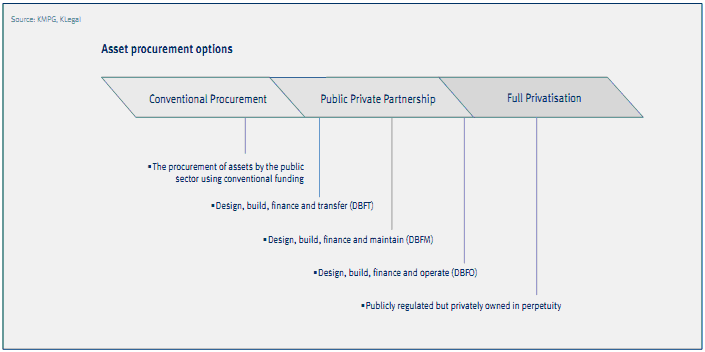
The concept of a working partnership between the private sector and public bodies is well established. Compagnie Générale des Eaux (CGE), launched in 1853 and the founders of Veolia Environnement, was contracted to supply water to the city of Lyons. The company was awarded a 50-year contract to supply water to Paris in 1860 and in 1867 won a contract with the municipality of Nantes to clear the streets of manure and refuse and to convert it into fertiliser.4
More recently, the last 25 years have seen a new phase in the development of PPPs. PPP toll tunnels were built in Hong Kong in the 1970s and American private prison companies were among the first in private provision of correctional facilities in the early 1980.5
Today, PPPs are common practice in delivering services. Many governments have already established such partnerships and achieved a great deal in delivering infra-structure - such as roads or buildings, or services such as offender management. Exhibit 2 (page 9) shows the different stages of PPP development.
Since the early 1990s, successive UK governments have used partnerships between the public and private sectors to deliver public services. Because of this wealth of experience the UK is seen as being at the forefront of PPP development and many countries are looking to this market to inform their own models. For example, the Spanish regional government of Valencia and that of Singapore have already launched build and refurbishment programmes for their schools, both adopting strategies similar to the Building Schools for the Future model recently developed in the UK.
But the introduction of PPPs as a means of delivering public services has not been universally welcomed in many places - including the UK. Public scepticism over private involvement in services has been witnessed in most countries adopting PPP programmes. Concerns over service quality, costs to taxpayers, employment impact and accusations of 'selling the family silver' are among the issues governments have been required to tackle. In some areas- again, including the UK - PPPs are still met with scepticism and a belief that the public interest is being sacrificed in favour of shareholder needs.
In the UK and many other countries, PPPs are actually proving themselves as vehicles for improving services and delivering not only efficiency savings but also generating better outcomes for citizens. PPPs are now particularly prevalent in sectors of industry where they have proven their worth: transport (roads, railways and airports), utilities (electricity, gas, water, sewage and telecoms) and amenities (lighting, social housing and accommodation) are all areas in which partnership between the public and private sectors have delivered value for money and improvement in services.6 But there are opportunities for governments looking to develop their PPP programmes beyond infra-structure and consider building in front-line service elements - as the UK has done in the healthcare, education, prison and local government sectors.
| CASE STUDY | Carillion in Canada |
| In October 2006, the Royal Ottawa Hospital became the first operational PPP hospital in Ontario. This involved expanding the existing hospital into a facility that specialised in treating people with severe mental illness across Eastern Ontario. One of the targets of this design construct and commission project was to avoid disruption to current patient care during the construction period. To achieve this Carillion developed the new facility on vacant land on the existing site of the hospital, using its experience in delivering hospital projects in the UK. | |
| CASE STUDY | BUPA in Spain |
| BUPA's Spanish subsidiary, Sanitas, has two high-profile PPP schemes - the La Moraleja Hospital, Madrid and in Manises, Valencia. In November 2005, BUPA opened the £32m La Moraleja Hospital in an expanding part of Madrid where the regional government wanted to rapidly provide more hospital facilities for the extra population. The hospital treats 200,000 patients a year and employs over 350 people. It is equipped with state-of-the-art technology due to private financing and provides a source of local employment. It was designed and built more rapidly than a public hospital could have been. The Minister of Health for the Madrid region visited BUPA's Redwood treatment centre in Surrey and was impressed with its results. He then spearheaded acceptance of a public private solution for further developments in Spain - clearly showing that the UK's experience is leading to change elsewhere in Europe. Following the success in the Madrid region, Sanitas is the lead partner in a joint venture which has just won a 15 - year PFI contract to manage and deliver a comprehensive range of GP, community and hospital services in Manises, on the outskirts of Valencia. Private investment is enabling high-quality medical care for local people - Dr Eduardo Cabrillo, Head of Obstetrics and Gynaecology at Sanitas La Moraleja hospital, said: "At La Moraleja, we are promoting the best health and care for our patients. We use the most innovative and evidence-based procedures across fields such as prenatal diagnosis, multiple pregnancies and medical complications in pregnancy ". | |