6.4.3. "Bow wave" and recent affordability issues
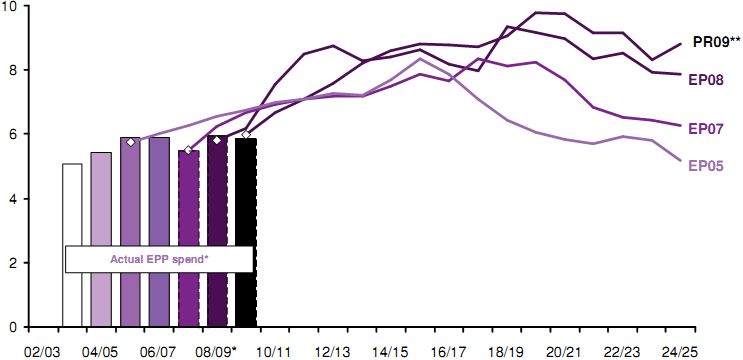
Figure 6-3 shows the projected total spend to 2024/25 for each of the last four planning rounds, as well as showing the actual47 spend in-year.
Total Equipment Procurement costs
C DEL + Direct R DEL (Billions of Pounds "Near Cash")
Note: Includes the cost of the future deterrent, which is subject to separate funding arrangements with the Treasury on the basis (announced in the 2006 White Paper) that the cost of the deterrent will not be at the expense of the conventional capabilities required by the Armed Forces;
* Actual EPP spend not tracked accurately since the formation of DE&S, so control totals are shown instead for 07/08, 08/09 and 09/10;
** PR09 is after options and manual adjustments (as at 23rd of April), but is not the final EPP
Source: CapEP
Figure 6-3: Total Equipment Procurement Plan costs over time
A pattern is evident in each planning round which shows a large forecast increase during the immediate future years (namely the first 10 years) before falling back, creating a "bow wave" effect, the steepness of which has been increasing over time48.
The level of difficulty in dealing with short to medium term affordability is illustrated by recent interventions in the process. These include:
• Move to Annual Planning Rounds. Since 2004/05 the PR process for the EPP was intended to be biennial, but the extent of annual drift is such that it has been done annually since 2007
• Commitment Control Regime (CCR); this an extra level of approval which ensures that new commitments are further reviewed prior to obligations being entered into
• Equipment Examination: An equipment examination was also undertaken during PR09 to relieve pressure and reprioritising spending. The consequences were announced in December 2008 and incorporate some significant changes in priorities for equipment procurement, including:
- a commitment to deliver the Warrior Capability Sustainment as quickly as possible;
- a decision to delay to FRES Utility Vehicle so as to ensure more rapid entry into service of the FRES Scout;
- engine upgrade for 12 Lynx Mk9 helicopters to increase available helicopter hours49; and
- delay to the in-service date of the Aircraft Carriers50 by 1-2 years, bringing it into line with that of the Joint Combat Aircraft.
__________________________________________________________________________________________________________________________________
47 Since the formation of DE&S, outturn spend on EPP procurement is no longer tracked explicitly; it is only possible to determine the total EP spend. Various methods of estimation are possible, but results appear unreliable, so control total targets have been shown for 2007/08 and 08/09 as a proxy for actual spend.
48 A "fall back" in planned spending in the longer term only appears because no plans have explicitly been included towards the end of the plan yet. Correspondents in the acquisition community believe that this gap will inevitably be filled and that the "bow wave" effect is therefore actually an illusion.
49 Using £70m from the Treasury Reserve. First aircraft to be available by end of 2009
50 Referred to within the Department as CVF