7.6. Potential lessons from UOR procurement
This Review has chosen to focus its analysis primarily on the "standard" EPP; however, it is also worth investigating the performance, at least in summary, of the Department's somewhat smaller UOR programme.
This programme is distinct from the EPP in that the requirement for specific equipment has been identified in operations as key to success, and it is therefore a priority to deliver the equipment to the battlefield in as short a time as is practicable. UORs follow a somewhat different approvals process to equipment on the EPP, which is set out in Figure 7-12.
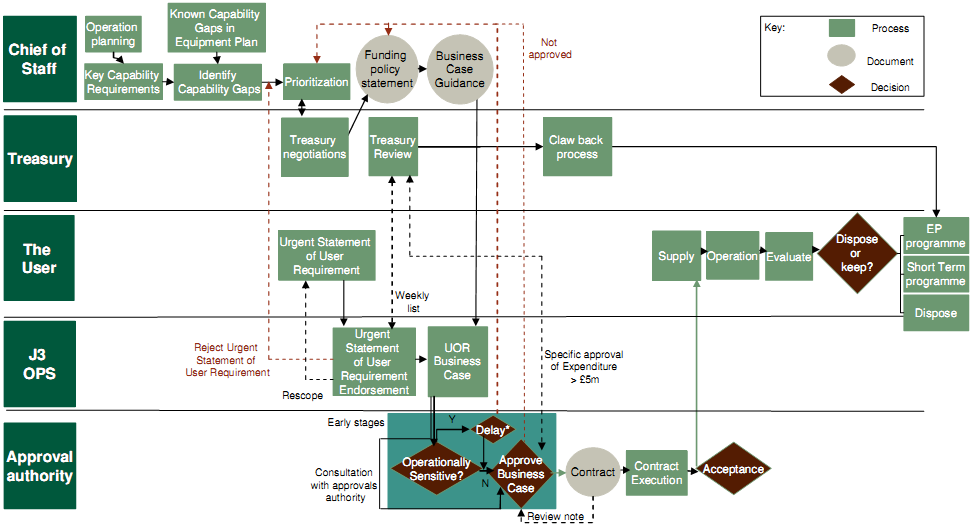
Note: * Delay while diplomatic efforst are exhausted
Source: NAO 'The Rapid Procurement of Capability to Support Operations' (Nov 2004)
Figure 7-12: UK UOR acquisition process
The general perception conveyed during discussions with the Front Line Commands is that the UOR process delivers capability more effectively than the standard EPP, and that there may be lessons which can drawn from this process to inform improvement in the EPP process.
From initial investigation of the data available to the review75, it is notable that "on-time" performance is somewhat better on UORs than on EPP projects (see Table 7-8).
| | Urgent Operational Requirements (UORs) | Equipment Plan Projects |
| % of projects delivered on | 88% | 52% |
| Average project overrun versus approved ISD90 | -1 month | +10 months |
Source: CMIS, Review team analysis
Table 7-8: UOR vs. EPP delay and cost overrun
A consequence of the UOR process is that, in contrast to dynamics elsewhere in the EPP, the time dimension of the Performance / Cost / Time envelope is significantly more important. As a result, more meaningful trade-offs are made between the dimensions in order to deliver the required core capability quickly, although it should be noted that UOR projects are typically both smaller and require less technological development. Hence the challenge with UORs is more time based rather than in overcoming technological complexity as opposed to the situation with the main programme. The Review team has also anecdotally identified that the tradeoff process itself is faster than in the standard EPP.
__________________________________________________________________________________________________________________________________
75 UOR performance has been analysed for a sample of 321 UORs that are captured in CMIS, of which over 75% have achieved ISD.
76 UOR projects – % of projects delivered, or forecast to be delivered, within latest approved ISD90. EPP projects – % of "mature" projects delivered, or forecast to be delivered, within MG approved ISD90.