7.8.1. Indistinct interface between customer and supplier
To deliver capability, the Capability Sponsor organisation and DE&S need to work closely together to ensure that User needs and perspectives are considered alongside the industrial, technical and financial constraints that arise in meeting these needs. However, in practice, close working has translated into lack of clear project ownership and has diluted accountability for poor project performance. Within the wider Defence community DE&S is often seen as "most responsible" for project difficulties, however the seeds of the problem were often sown in the planning and optimistic initial costings incorporated into the MoD's long term planning systems, providing DE&S with an almost impossible task to deliver to time and budget from the outset. As a result, and as already discussed in Chapter 6, it is often not clear whether overruns are down to this mis-estimation, ineffective project management, supplier failings, or a combination of all three.
Furthermore, anecdotal evidence suggests that the close working relationship between DE&S and the Capability Sponsor means that change requests are often accepted by DE&S after internal approvals have been granted against an agreed specification (and contracts signed with industry), leading to further overruns that become associated with DE&S. The lack of reliable data relating to changed requirements, noted earlier in this chapter, supports this hypothesis.
It is worth noting that the current situation has not always prevailed. Prior to the formation of DE&S and the "Unified Customer" the core new equipment project delivery functions for the MoD were largely undertaken by the DPA which operated based on a clear customer / supplier relationship with the rest of the MoD. This arrangement was driven by Smart Procurement changes:
"The role of the PE should be that of a supplier of equipment procurement services, a role which requires clear definition of the customer-supplier relationships with the centre and the Single Service, and which allows the Procurement Executive to move to Trading Fund status"78
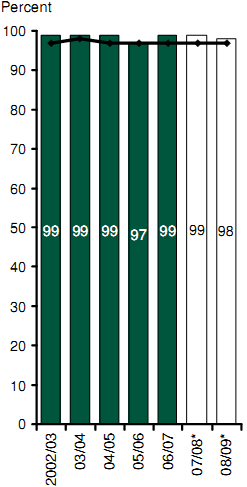
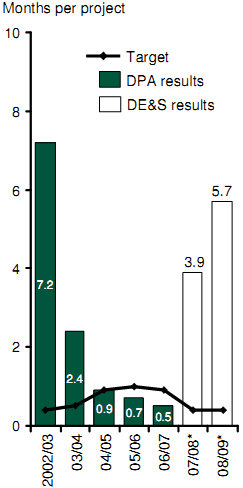
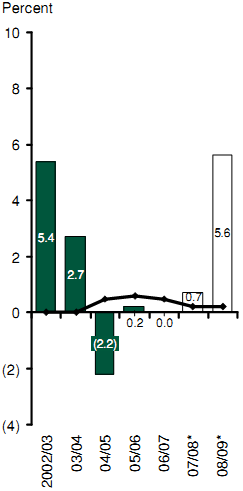
Ultimately agency status, rather than a trading fund, was used to provide the procurement function with the required degree of autonomy. The performance of the DPA against its Key Performance Indicators (as set by the Department) is shown in Figure 7-14.
Equipment performance in year - Percentage of KURs being met, average per project | Average programme slippage in year | Average percentage cost growth in year |
|
|
|
Note: * DSO population Key Target Results
Source: DPA Annual Reports; DE&S internal KPI reports
Figure 7-14: DPA and DE&S Key Performance Indicators
Performance against cost and time KPIs improved significantly between 2002/03 and 2006/07 during the DPA's existence, eventually exceeding targets on all dimensions. In addition KUR performance remained high..
However, the perception of the rest of the MoD was that it failed to adequately incentivise the DPA to optimise outputs against "second order" MoD goals (i.e. those against which its performance was not explicitly and transparently measured). The organisation suffered from a perception that it was adversarial in its dealings with the rest of the MoD, was generally unresponsive and was delivering the wrong equipment (despite apparently good performance on delivering KURs). In reality, how much of this perception was genuinely the fault of the DPA and how much was a result of failures of the FLCs and MoD centre organisation in realism and stable specification is unclear.
The subsequent changes to the MoD's acquisition system which resulted in the creation of the "Unified Customer" and which reabsorbed the DPA into the MoD in April 2007 were meant to create "one team" but had the adverse effect of blurring the division between the customer and supplier in the relationship with consequences for clarity of purpose and accountability.
As a result, functions that were in principle meant to be the main responsibility of one are now performed by the other or both. Specifically, DE&S finds itself in a position where it is able to trade off capability against other factors and where it is therefore partly free to determine the capability that is ultimately delivered (even though this is the explicit role of the Capability Sponsor).
__________________________________________________________________________________________________________________________________
78 "Transforming the U.K.'s Defence Procurement System", MoD, (Feb 98)