7.9.3. Progress with Contracting for Availability
Implementation of CfA arrangements with industry aims to transform the way in which the MoD delivers support and repair of equipment. Traditionally, support was provided in the context of a customer-supplier relationship, in which the Department held the majority of risk and industry provided spares and maintenance services. By contrast, CfA partners MoD with industry in joint working teams. Risk is apportioned between the two parties, with Contractors incentivised to meet specified availability and reliability targets. In this way, CfA support solutions require the contractor to take on the risk of availability, and provide incentives that seek to drive down the long-term costs of support.
For existing equipment where support arrangements are already in place migration to CfA involves the contractor taking over all the existing support contracts, repair schemes and exiting services. For new equipment, contractors are free to come up with whatever solution they deem appropriate. Most arrangements also require the MoD to deliver resources (e.g., manpower, infrastructure) and to work with the contractor to deliver the support solution.
The NAO have separately reported82 on the significant benefits delivered by the MoD's CfA approach. In particular, they have noted that costs of Tornado and Harrier support have improved significantly since these arrangements were put in place (see Figure 7-17).
Cost per flying hour for Tornado and Harrier aircraft (2002-07)
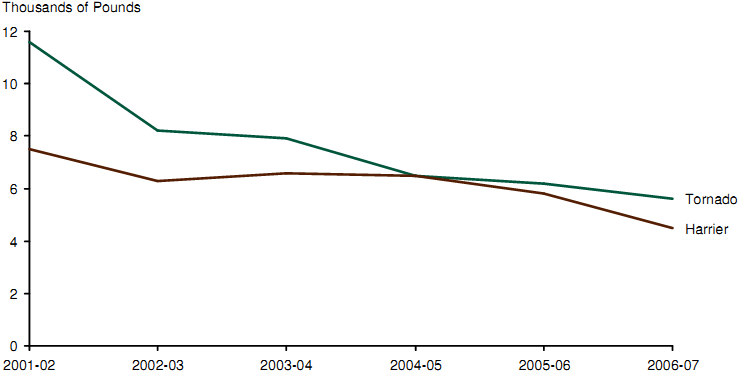
Note: Harrier budget excludes the capital cost of the GR9 upgrade programme Source: NAO analysis
Figure 7-17: Cost per flying hour for Tornado and Harrier aircraft
However, in order for industry to deliver these benefits, there is a need to invest in a support solution upfront. This investment can then only be recovered over the duration of the contract. As a result, contracts delivering significant efficiencies will also tend to be long (10 - 15 years). The MoD will then have to provide guarantees around the minimum levels of activity to be provided, which provides a clear constraint on the MoD's activities (before incurring "inefficient" financial penalties) and therefore potentially reduces the MoD's flexibility in meeting changing defence priorities83.
With regards to new equipment, industry will both procure and provide the support provision for a given equipment contract (or suite of contracts). As such, if put in place during the early phases of the CADMID cycle, CfA is also able provide suitable incentives to contractors during the CADM phases to reduce in-service support costs through appropriate investment during initial design and manufacture.
__________________________________________________________________________________________________________________________________
82 Transforming logistics support for fast jets' NAO (July 2007)
83 An alternative view has also been heard by this Review: that the apparent flexibility in the existing system does not really exist due to wider MoD cost / capability considerations. The Review team finds this assertion credible but has not further investigated due to time constraints.