10.5.2. Approval system description
Significant investment decisions are approved by an Investment board which is chaired by the Minister of Defence. This body is responsible for decisions relating to investments in both military equipment and other projects that impact the ministry, such as those relating to infrastructure and IT systems.
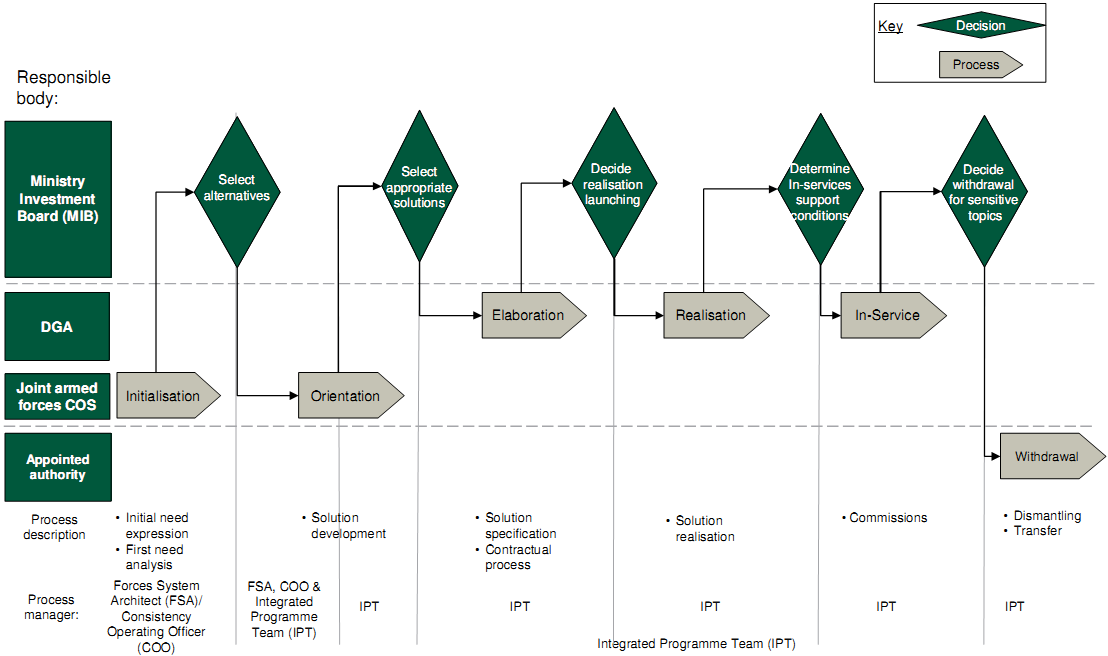
French equipment planning is predicated on a lifecycle description that is composed of six different stages, as indicated in Figure 10-3. Progression between stages requires explicit approval from the MIB, who assess whether the project is sufficiently advanced to move beyond each milestone or whether additional work needs to be completed. In total, therefore, the MIB approves each project four times before it enters service.
Source: DGA
Figure 10-3: French acquisition process
By structuring the decision making process around a Ministerial Investment Board ("MIB"), responsibility for decisions is clearly held by the politicians in charge. In principle, the role of the administration then becomes one of implementing ministerial decisions137. In this arrangement, the minister's responsibility extends beyond the management of the portfolio of projects that are underway, but to the success (or otherwise) of individual projects too.
In making investment decisions, the MIB is informed by the opinions of two subcommittees. One of these is composed of members of the Armed Forces and is charged with advising on capability needs. The other committee comprises project commercial and technical specialists from DGA and comments upon whether programmes can be delivered in the timescales and budgets available. The minister is therefore explicitly responsible for trading off aspirational objectives against practical concerns.
_______________________________________________________________________________________________
137 In practice, although the administration has no official responsibility for decision making, it does inform the process and is therefore in a position to influence the decisions that are made.