E.7.3. Cost inflation of projects in the EPP
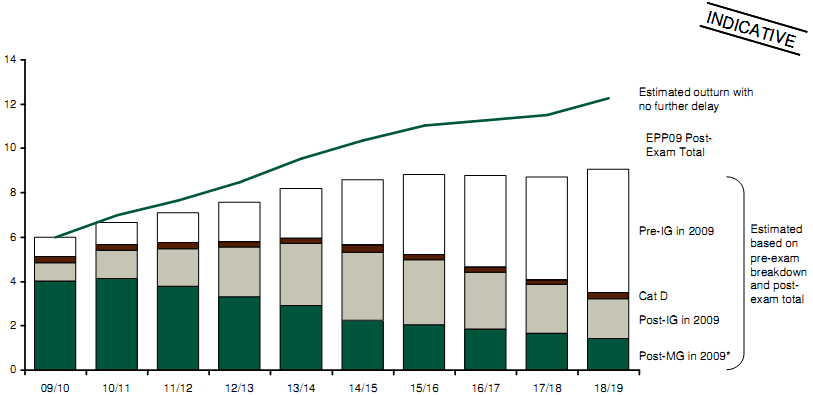
Chapter 7 showed that the average growth in project cost from Initial Gate over the lifetime of the project was 42% of the estimate made at Initial Gate. The projects currently in EPP have a range of maturities and have suffered from cost overruns to a greater or lesser degree. Figure E-7 shows an estimated segmentation of the current EPP by approval status. If the performance of cost overruns does not change, based on the currently observed levels of forecast cost overrun, an increase in costs of c.5% for projects currently post-Main Gate and c.17% for projects currently in Assessment phase is expected. Concept phase projects, assuming there are no increases in cost forecasts until Initial Gate, are therefore expected to incur the full 42% cost growth over their lifetime, and Category D projects170 are conservatively assumed to have the same mix of cost overruns as Category A-C post-Main Gate projects.
Total Equipment Procurement Programme costs
Note: * Includes Typhoon T1 development, Typhoon T2 production, Typhoon T3, PAAMS, JCA Prod Sustainment phase 1, and QinetiQ LTPA Source: DEP data; Review team analysis
Figure E-7: Segmentation of expenditure in the first ten years of the current EPP by project phase171
Considering the average progress of the projects from Initial Gate to ISD and the amount of historical spend, it is therefore possible to forecast the outturn EPP expenditure assuming no further delay, as given by the line in Figure E-7. The expected cost overruns mean that c.£16bn of additional expenditure in the EPP is required over the next ten years.
_______________________________________________________________________________________________
170 Not present in CMIS in February 2009 so no cost forecasts were available
171 Segmentation based on EPP09 stage 3b, pre-equipment exam/pre-options, correct as of 24 March 2009. Total correct for the post-equipment exam/post options EPP09, correct as of 23 April 2009.