E.7.4. Delay of projects in the EPP
This indicative analysis of the EPP assumes that the costs of projects would grow but there would be no further delays. Conversely, assuming that all cost overruns are associated with delays, if expenditure is constrained to current levels, then planned expenditure will have to be deferred to subsequent years, incurring additional 'inefficient' spend, which is necessarily unproductive. If this spend is consumed immediately, then, more expenditure must be deferred, and this can lead to exponentially increasing levels of unproductive spend (as found in E.2).
Figure E-8 shows an example where annual expenditure is constrained to current levels given the planned EPP.
EPP expenditure when constrained
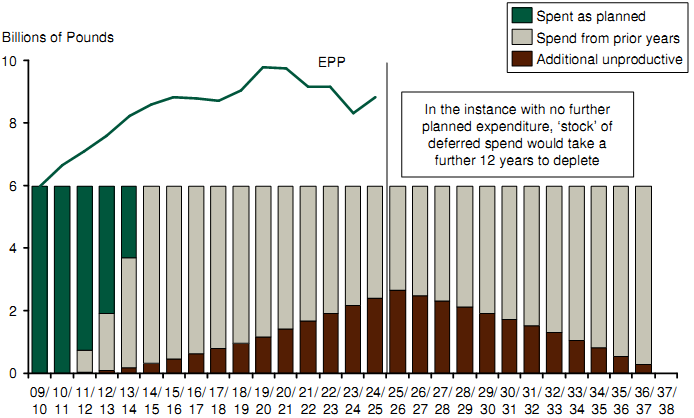
Figure E-8: Forecast EPP expenditure if spending is constrained to current levels. Additional unproductive spend (red bars) increases exponentially as increasing amounts of spend is deferred.
Since the EPP requires expenditure above c.£6bn in 2010/11, the additional unproductive spend arising demands the delay to some projects. This unproductive spend causes yet more expenditure to be delayed. The problem is exacerbated by the fact that the EPP consistently requires expenditure above c.£6bn. In the example above, by 2024/25 a third of annual expenditure is consumed by additional unproductive spend and it would take 12 years to deplete the 'stock' of deferred spend even if no further spend were planned.
The implications of a modest slippage in time, if allowed to continue year on year, could therefore be very significant on the productivity and cost of productive output from the programme.