Conduct of the First National Infrastructure Audit and Development of the First Infrastructure Priority List
10. The first Infrastructure Priority List was originally to be completed by March 2009, for consideration by the Council of Australian Governments (COAG.13 It had been envisaged that development of the Priority List would be informed by the outcomes of the first National Infrastructure Audit, due to be completed by December 2008. However, following the onset of the global financial crisis, COAG brought the timeframe for completion of the first Priority List forward to December 2008, to be due at the same time as the completion of the first Audit.14 In bringing forward the due date for the first Priority List, COAG noted that the Audit and Priority List were to be provided in the form of an 'interim' report. The original COAG deadline of March 2009 was retained for the completion of a 'final' Priority List.
11. The truncation of an already tight timetable added to the challenges faced by Infrastructure Australia in conducting the first National Infrastructure Audit and in developing the first Infrastructure Priority List. In particular:
• this was the first time a non‐sector specific list of priority infrastructure projects was to be prepared at the Commonwealth level such that the List published in December 2008 included infrastructure projects in the transport, energy, telecommunications, water and health sectors; and
• the Office of the Infrastructure Coordinator was required to develop and implement its own administrative arrangements and make the necessary staff and advisory appointments for its operations concurrently with conducting the National Infrastructure Audit, developing the Priority List and preparing and publishing national Public Private Partnership Guidelines.
12. The COAG deadline of December 2008 was met, with advice on the Audit results and a draft Interim Priority List being provided to the Minister on 5 December 2008. The Audit results and an Interim Priority List of 94 projects were publicly released on 19 December 2008 in a report titled A Report to the Council of Australian Governments. In respect to the Interim Priority List of 94 projects, the report stated that:
In order to finalise the Infrastructure Priority List, Infrastructure Australia proposes to:
• subject the data underpinning the assessment of strategic fit to further detailed scrutiny;
• request the development of comprehensive economic analysis of selected projects, where only a rapid economic analysis is available at this stage;
• ask submitting organisations to provide comprehensive economic analysis of specified projects immediately, if currently available;
• request and scrutinise the detailed demand modelling underpinning the projects; and
• subject the economic modelling methodology to further scrutiny.15
13. A Final Priority List was released by the Minister on Tuesday 12 May 200916 within a document titled National Infrastructure Priorities: Infrastructure for an economically, socially and environmentally sustainable future.Specifically the document stated that:
• nine 'priority' projects had been identified and should be considered for funding from the Building Australia Fund (together with a tenth project, being the Ipswich Motorway); and
• 28 'pipeline' projects were considered to show potential but further project development and analysis was required before Infrastructure Australia considered it would be able to make a funding recommendation to the Australian Government.
14. A key aspect of the Infrastructure Australia analytical framework for the Infrastructure Priority List was the development of a staged assessment process to prioritise between investment proposals, drawing from international and nationally‐based practices and research. Of note was that the published methodology outlined that objective cost‐benefit analysis (through Benefit‐Cost Ratios or BCRs) would be used as the 'primary driver' of decision‐ making but they were not the only consideration. Consistent with the published methodology, a structured approach was planned by the Office of the Infrastructure Coordinator to combine the economic appraisal of a project's BCR with its assessment of each candidate project's 'strategic fit' in order to identify those projects worthy of further consideration (at the Interim Priority List stage) and, subsequently, to be included on the Final Priority List.
15. Figure S 1 summarises the key points in the development of the Final Priority List. Figure S 1 also outlines how the Final Priority List has played an important role in Government funding decisions with seven of the nine priority projects having been announced for funding and 10 of the 28 pipeline projects similarly having been announced for funding.
Figure S 1 Key points in the development of the Infrastructure Priority List
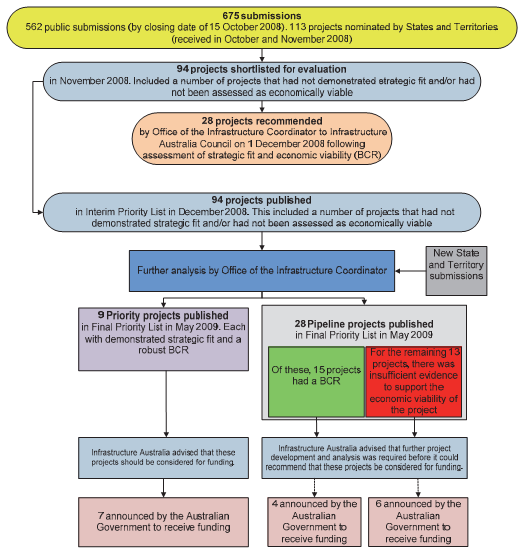
Source: ANAO analysis of records of the Office of the Infrastructure Coordinator
___________________________________________________________________________________________
13 COAG Meeting Communique, 26 March 2008.
14 COAG Meeting Communique, 2 October 2008.
15 Infrastructure Australia, A Report to the Council of Australian Governments, December 2008, p. 72.
16 The Hon Anthony Albanese MP (Minister for Infrastructure, Transport, Regional Development and Local Government), Investing in the Nation's Infrastructure Priorities, Media Release, 12 May 2009.