Infrastructure Australia's work on the National Infrastructure Audit
2.10 Infrastructure Australia was responsible for assessing the submissions made to the National Infrastructure Audit. However, submissions were requested in April 2008, prior to the first meeting of the Infrastructure Australia Council (4 June 2008) and prior to the commencement of the Infrastructure Coordinator (1 July 2008). As such, Infrastructure Australia had no input into the format or content requested of initial submissions made to the National Infrastructure Audit.
2.11 The Office of the Infrastructure Coordinator advised ANAO in April 2010 that:
By the end of July 2008, States and Territories submitted to the Office of the Infrastructure Coordinator their responses to the April 2008 request from the Minister for Infrastructure, Transport, Regional Development and Local Government.
The information supplied to Infrastructure Australia did not permit any detailed estimation of the capacity [or] adequacy of the nation's infrastructure networks sufficient to identify gaps in our infrastructure system. One of the reasons that relevant information was not supplied lies in the fact that it was not sought or agreed via the Infrastructure Working Group template. The template only permitted, at best, high level information regarding individual jurisdiction's perceptions of infrastructure capacity. Indeed, the submissions to the Audit were limited to approximately 50 pages.
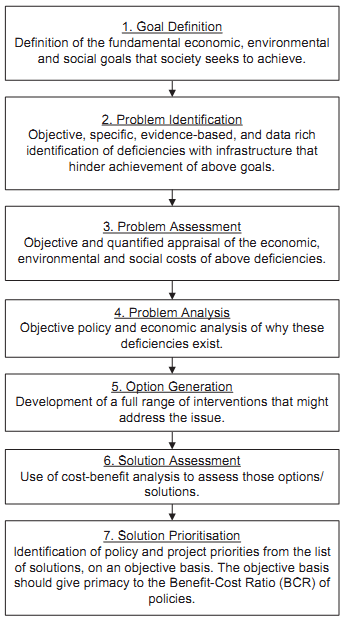
2.12 In its second meeting held on 30 July 2008, the Infrastructure Australia Council endorsed an analytical framework for undertaking the National Infrastructure Audit. This seven‐stage process was to be the benchmark against which to assess State and Territory submissions. This is outlined in Figure 2.1.
Figure 2.1 National Infrastructure Audit analytical framework
Source: ANAO summary of paper provided in Infrastructure Australia Council Meeting Papers dated 30 July 2008.
2.13 The Office of the Infrastructure Coordinator wrote to each of the State and Territory governments70 in August 200871 seeking further information in the context of the new analytical framework. The Office of the Infrastructure Coordinator advised ANAO in April 2010 that:
The intent was to gain necessary detail beyond that already provided under the Infrastructure Working Group's template, which Infrastructure Australia inherited.
2.14 The Office of the Infrastructure Coordinator requested the following further information from each of the States and Territories, in relation to the 'problem assessment' and 'solution assessment' stages of the Audit:
• an objective and quantified appraisal of the economic, environment and social costs of the infrastructure deficiencies that have been identified in the initial Audit submission, to enable it to better understand the costs and impacts of these deficiencies and thus allow for the most pressing matters to be identified and prioritised (the 'problem assessment'); and
• an understanding of the economic and financial appraisal methods used to prioritise particular infrastructure projects, and in particular a copy of any cost‐benefit analyses that had been made of those projects and on any other proposed regulatory reform options (the 'solution assessment').
2.15 This advice was due by 31 August 2008.72 However, for most State and Territory governments, this request was supplemented by a 23 September 2008 request for input from State and Territory Governments and the ARTC. In this respect, the Office of the Infrastructure Coordinator advised ANAO in May 2010 that:
The 23 September 2008 request reflected the ongoing analytical work that was being undertaken to support the Audit and the development of the Infrastructure Priority List. As noted in the Minutes of its meeting on 29 August 2008, [the] Infrastructure Australia [Council] had been provided with a presentation of the 'first cut' of the audit/prioritisation process. As this work progressed and was 'fine tuned', it became evident that further information was required from the jurisdictions. It is worth noting that, during this period, Infrastructure Australia was in regular two‐way dialogue with the jurisdictions. Contact with the jurisdictions was not limited to the letters of August and September 2008.
2.16 In August 2008, the Office of the Infrastructure Coordinator also wrote to five Commonwealth Departments73, four other Commonwealth government entities74; the Australian Energy Market Commission (a joint Commonwealth‐ State body); and three peak bodies75 seeking information. The objective of this further input was to identify:
• whether cross‐jurisdictional issues had been adequately captured in State/Territory submissions;
• gaps not covered by the previous submissions (such as infrastructure regulation);
• learnings and implications from relevant previous audits and reviews;
• input from any concurrent national reform activities; and
• to obtain Commonwealth advice on issues raised by the States and Territories.
2.17 In August 2008, the Minister for Infrastructure, Transport, Regional Development and Local Government and the Chair of the Infrastructure Australia Council called for members of the public and business community to provide evidence‐based submissions to inform the National Infrastructure Audit, the Infrastructure Priority List and the development of guidelines for Public Private Partnerships.76 In May 2010, the Office of the Infrastructure Coordinator advised ANAO that:
The call for public submissions is significant. It reflected Infrastructure Australia's view that this process should be transparent and seek views from a range of groups. This material, along with material from the jurisdictions, helped inform Infrastructure Australia of the challenges ahead.
2.18 A range of material was provided by the general public and States and Territories following the various requests.
___________________________________________________________________________________________
70 The Office did not seek further information from the Brisbane City Council or the ARTC in this round of information requests.
71 For some of these letters, two signed copies were on the Office of the Infrastructure Coordinator's file with different dates, and it was not apparent which of the letters had actually been sent.
72 The Office of the Infrastructure Coordinator subsequently wrote to the New South Wales Premier on 18 September 2008 to confirm that the submission previously forwarded remained current or alternatively to request that he advise of any changes to the New South Wales submission or the identified priority projects in light of the recent changes in the New South Wales Government. Similarly, the Office of the Infrastructure Coordinator wrote to the Western Australian Premier on 18 September 2008 to confirm that the submission forwarded by the previous government remained current, or alternatively to request that he advise of any changes to the Western Australian submission in light of the recent election. In both of these letters, the Infrastructure Coordinator requested that he be advised on these matters by the end of October 2008.
73 These were: the Department of the Environment, Water, Heritage and the Arts; the Department of Climate Change; the Department of Broadband, Communications and the Digital Economy; the Department of Infrastructure, Transport, Regional Development and Local Government; and the Department of Resources, Energy and Tourism.
74 These were: the National Water Commission; the Productivity Commission; the Australian Competition and Consumer Commission; and the Australian Energy Regulator.
75 These were: the Energy Users Association of Australia; the Water Services Association of Australia; and the Australian Council of Social Service.
76 The Hon Anthony Albanese MP (Minister for Infrastructure, Transport, Regional Development and Local Government) and Sir Rod Eddington (Chair of Infrastructure Australia), Infrastructure Australia calls for public submissions, Joint Media Statement, 31 August 2008.