Adoption of a staged appraisal process, with economic appraisal to be a primary driver in decision-making
3.6 A key aspect of the Infrastructure Australia framework was the development, drawing from international and national‐based practices and research,89 of a staged assessment process to prioritise between investment proposals. In this respect, amongst other sources, Infrastructure Australia's approach drew on the National Guidelines for Transport System Management (National Guidelines) which were endorsed by the Australian Transport Council in November 2004, and updated in December 2006.
3.7 As outlined in ANAO Audit Report No. 29 2008-09, Delivery of Projects on the AusLink National Network, the National Guidelines advocate that all proposed projects should be subject to the same appraisal process and that appraised proposals should be prioritised to develop a forward program of preferred initiatives through a transparent process that is founded on sound economic and business investment principles.90 The framework set out in the National Guidelines uses a three‐stage appraisal process, illustrated in Figure 3.1. The intention is that the projects that pass through all filters demonstrate strategic merit and fit, and perform well in a detailed appraisal, which is to be a:
comprehensive analysis of the impacts and merit of an initiative. A detailed appraisal usually involves detailed Benefit‐Cost Analysis, a financial or budget assessment, and specific impact analyses and impact statements (for example, environmental, social, regional, employment, equity). All relevant monetised and non‐monetised impacts need to be assessed.91
Figure 3.1 Three-stage appraisal process for infrastructure projects
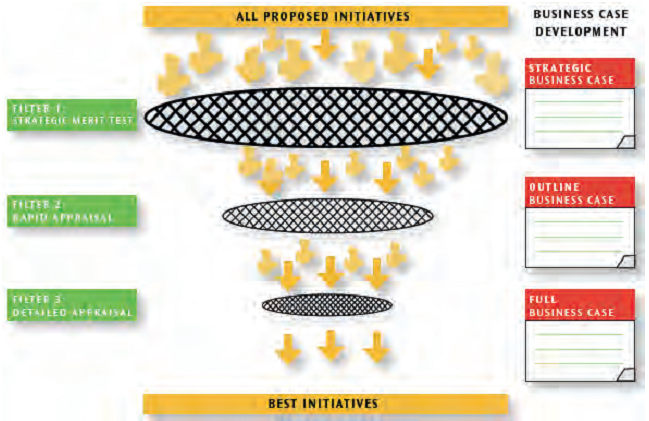
Source: Australian Transport Council, National Guidelines for Transport System Management in Australia, Volume 2-Strategic transport planning and development, December 2006, p. 54.
3.8 Similar to the stage appraisal process illustrated in Figure 3.1, Infrastructure Australia's Prioritisation Methodology involved three phases:
• profiling, being an analysis of the project's 'strategic fit'-how well the project would meet Infrastructure Australia's strategic priorities;92
• appraisal, which combined monetised cost‐benefit analysis of candidate projects (measured principally through a projects Benefit‐Cost Ratio, or BCR) with analysis of an initiative's non‐monetised effects to determine the wider economic, environmental and social merits of an initiative; and
• selection, in which the outputs of the preceding profiling and appraisal phases were to be used to create a priority list of initiatives to enable informed decision‐making for the allocation of funding.
3.9 Under the Prioritisation Methodology, the profiling and appraisal assessments were to be undertaken by project proponents and reviewed by Infrastructure Australia, whereas the selection phase was solely Infrastructure Australia's responsibility. The Prioritisation Methodology document contained three proformas to assist project proponents in providing information to Infrastructure Australia. These were the 'Summary of Initiative Profiling' (for the profiling phase), the 'Summary of Initiative Appraisal Key Results and Assumptions' (for the appraisal phase) and 'Further Inputs For Initiative Selection' (which provided information about a project's deliverability, timing and packaging with other projects).
3.10 For each of the assessments, a set of rules was developed to promote objective and comparable assessments. Where appropriate, for instance to validate the economic studies provided by project proponents, external advisors were used to carry out the assessment.93
3.11 The methodology also had regard to the practical circumstances faced in the context of developing the first Infrastructure Priority List. In particular, it allowed for project proposals to be at different stages of development. For example, it was expected that some projects would be 'ready to go', some would be at the conceptual stage but that many were likely to be somewhere along the spectrum between these two points. Accordingly, Infrastructure Australia expected there to be variation in the depth and thoroughness of submissions.
3.12 Overall, Infrastructure Australia's methodology provided a robust framework for the development of the first Infrastructure Priority List. It was not radically innovative in substance but reflected fundamental elements that have long been advocated as being central to good infrastructure policymaking. In particular, Infrastructure Australia proposed to use objective cost‐benefit analysis (through BCRs) as the 'primary driver' of decision‐ making.94 In this respect, the Prioritisation Methodology outlined that:
Cost‐benefit analysis (CBA) is the primary appraisal tool by which Infrastructure Australia assesses the net benefit of an initiative. It is an objective tool that combines 'monetised' benefits and costs - those expressed in dollar value terms. In the Infrastructure Australia methodology, as many benefits and costs are monetised as widely as possible. Estimates of wider economic benefits and costs (WEBs) are to be included where relevant…95
___________________________________________________________________________________________
89 Infrastructure Australia, Outline of Infrastructure Australia's Prioritisation Methodology, 24 September 2008, p. 3.
90 Australian Transport Council, National Guidelines for Transport System Management in Australia, Volume 1-Introduction to the Guidelines and Framework, December 2006, pp. 18-20.
91 ibid., p. 19.
92 See further at paragraph 4.9
93 DITRDLG published a request for tender in May 2008 to establish a panel of consultants to assist Infrastructure Australia in its work. The Tender Evaluation Committee recommended in September 2008 that 18 of the 87 tenders received be included on the panel, and that the Department enter into contract negotiations with these 18 tenderers. Regulation 9 approval for the panel was signed on 14 May 2008, up to a value of $5.25 million (GST inclusive).
94 Infrastructure Australia, Outline of Infrastructure Australia's Prioritisation Methodology, 24 September 2008, p. 4.
95 ibid., p. 5.