Submission processes
3.19 In order to develop the best possible list of projects, and to ensure equitable treatment of proponents, it was important that all proponents had adequate opportunity to submit information to Infrastructure Australia in support of their application. In this context, the Evaluation Plan on the Interim Priority List emphasised that the evaluation would be undertaken in accordance with the principle of fairness, with all submissions and proposed initiatives to be treated equally and fairly and evaluated strictly in accordance with the Plan.
3.20 As outlined in Figure 3.3, there were two major information requests in relation to the preparation of the Interim Priority List. These were:
• a request from the Minister for Infrastructure, Transport, Regional Development and Local Government and the Chair of the Infrastructure Australia Council on 31 August 2008, calling for public input to inform Infrastructure Australia's three immediate tasks of conducting the National Infrastructure Audit, producing the Infrastructure Priority List and developing nationally consistent guidelines for Public Private Partnerships by 15 October 200897; and
• 23 September 2008 letters to States, Territories and the ARTC, in line with the Prioritisation Methodology, by 31 October 2008.
Figure 3.3 National Infrastructure Audit and Infrastructure Priority List timeline
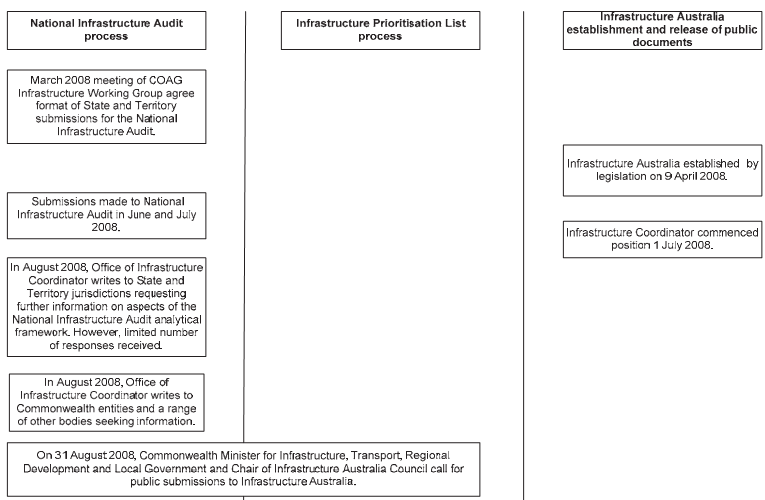
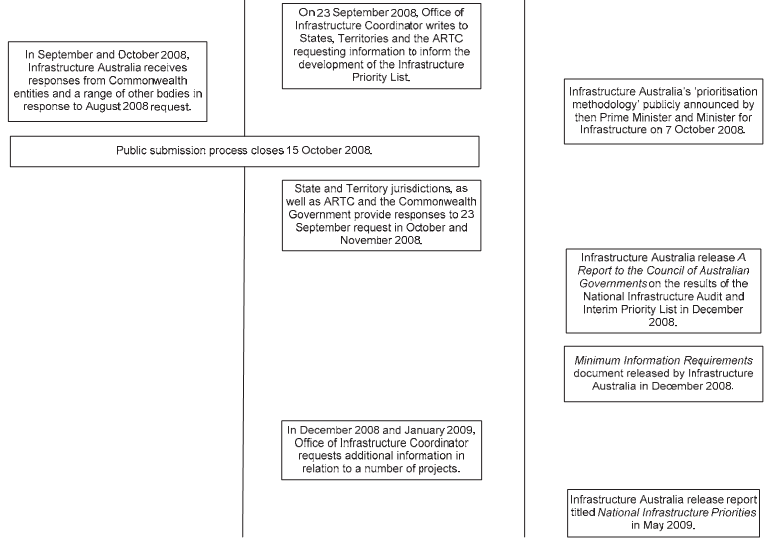
Source: ANAO analysis of Office of the Infrastructure Coordinator data
3.21 Although both requests for information informed the development of the Interim Priority List, the information requested by Infrastructure Australia was different. Prior to the September 2008 request to States, Territories and the ARTC, Infrastructure Australia had already received a range of information from these bodies in relation to the National Infrastructure Audit. Infrastructure Australia has noted that the information requested in relation to the National Infrastructure Audit was outside its control (as the call predated its inception).98
3.22 The September 2008 request for information related primarily to the development of the Infrastructure Priority List, but also connected the request with the National Infrastructure Audit process. In September 2008, Infrastructure Australia had also developed a revised Prioritisation Methodology. The Office of the Infrastructure Coordinator requested that the States, Territories and ARTC provide information that was in line with this revised methodology.
3.23 By way of comparison, the information request for the 'public' submission process was quite broad. Proponents were asked to provide input to inform a range of tasks, including the development of the Priority List, the conduct of the National Infrastructure Audit and the development of Public Private Partnership Guidelines. Infrastructure Australia publicly released two discussion papers ('Australia's Future Infrastructure Requirements' and 'Public Private Partnerships') and a Submissions Guide, on 1 September 2008, to assist those proposing to make submissions. Given the broader scope of the information request from Infrastructure Australia, input from proponents in this process was understandably more varied than the input provided by the States, Territories and the ARTC.
3.24 In addition, the guidance material released on 1 September 2008 to assist those making submissions in the public submissions process did not contain reference to the revised Prioritisation Methodology. The revised Prioritisation Methodology was released by Infrastructure Australia on its website on 26 September 2008, 19 days before the public submission process closed. It was publicly announced by the then Prime Minister and the Minister for Infrastructure, Transport, Regional Development and Local Government on 7 October 2008. Consequently, whilst the Evaluation Plan for the Interim Priority List emphasised the importance of completing each step of the Prioritisation Methodology process, most non‐State and Territory Government submissions did not reflect the revised Prioritisation Methodology in their submissions.
3.25 In May 2010, the Office of the Infrastructure Coordinator advised ANAO that it would have been desirable for the methodology to have been publicly available for a longer period but the demands on the Office at the time and the limited resources available meant it was not practical to have released the material any earlier. The Office of the Infrastructure Coordinator further advised ANAO that, in its view, the public's ability to submit proposals for the Priority List had not been constrained by the approach adopted. More specifically:
The public had the ability to choose: on what to provide input; how much detail to provide in their submissions; and on what basis it was submitted. …Some private proponents did use the templates and methodology. In any event, there is a practical distinction between the submissions from jurisdictions and members of the public. This distinction reflects the fact that:
• the jurisdictions own many of the principal infrastructure networks, and therefore can decide what happens to those networks (whereas members of the public can only make suggestions as to what might happen to those networks);
• the information and resources required to make the well‐documented submissions were unlikely to be available to members of the public (in other words, only infrastructure owners/managers were likely to have the detailed information on asset utilisation, prospective demand and the like necessary to document their submissions). The alternative would have been to develop the Infrastructure Priority List based on submissions that were limited in their content; and
• without some form of jurisdictional support, privately proposed projects could not proceed.
___________________________________________________________________________________________
97 The Hon Anthony Albanese MP (Minister for Infrastructure, Transport, Regional Development and Local Government), and Sir Rod Eddington (Chair of Infrastructure Australia), Infrastructure Australia calls for Public Submissions, Joint Media Statement, 31 August 2008.
98 ANAO Audit Report No.29 2008-09, Delivery of Projects on the AusLink National Network, Canberra, 23 April 2009, p. 220.