Report structure
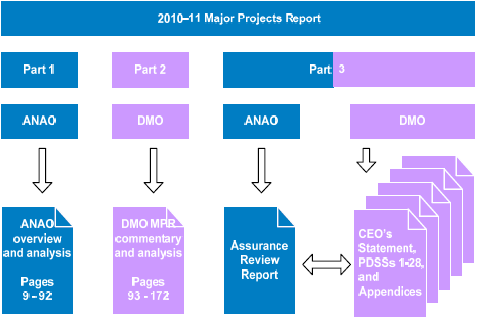
1.4 This report is organised into three parts as shown in Figure 1:
• Part 1 comprises the ANAO's overview, incorporating a Summary, Chapter 1 2010-11 MPR Review, Chapter 2 Projects' Performance, and Chapter 3 Governance and Business Processes;
• Part 2 comprises the DMO's commentary and analysis (not included within the scope of the Auditor-General's formal review); and
• Part 3 incorporates the Auditor-General's assurance review report; a statement by the Chief Executive Officer (CEO) of the DMO; and the 28 PDSSs prepared by the DMO as part of the assurance review process.
Figure 1
Report structure
1.5 The PDSSs describe each project and contain information on individual project performance according to the approved budgeted cost and expenditure, schedule and the DMO's assessment of progress toward delivering those aspects of key capabilities for which the DMO is responsible. This information has been prepared by the DMO having regard to the guidelines provided to project offices for completing the PDSSs.36 Each PDSS comprises:
• Section 1-a summary of the project, including project description, the project's current status, project context, unique project features, major challenges, and reference to other projects that depend on the reported project to achieve their objectives;
• Section 2-an outline of the project's budget and expenditure, and variances that have occurred over the life of the project to date, as well as major contracts in place (and quantities delivered as at 30 June 2011);
• Section 3-information on the project's design development and test and evaluation status; forecasts of the expected timing of projects achieving Initial Operational Capability (IOC)37 and Final Operational Capability (FOC)38; and, for the first time, forecasts of the expected timing of projects achieving Initial Materiel Release (IMR)39 and Final Materiel Release (FMR)40 are also included;
• Section 4-a summary of the DMO's assessment of progress on delivering key capabilities (also referred to as Measures of Materiel Capability Performance);
• Section 5-an outline of the major risks and issues faced by the project;
• Section 6-a summary of project maturity and comparison to benchmark;
• Section 7-an outline of the key lessons that have been learned; and
• Section 8-a summary of the project's line management details.
1.6 The statement by the acting CEO DMO (p. 180) lists significant events that have taken place affecting the status of projects as set out in the PDSSs, since 30 June 2011.
1.7 Understandably, and consistent with the guidelines, information of a classified nature has been excluded from the PDSSs.
__________________________________________________________________________________
36 The guidelines for the 2010-11 MPR, which were endorsed by the JCPAA in May 2011, set out the requirements for the DMO project offices to provide complete and accurate Project Data Summary Sheets and supporting information for the ANAO to review.
37 Initial Operational Capability (IOC): The point in time at which the first defined subset of a capability system that can be operationally employed is realised. IOC is a capability state endorsed at project approval at Second Pass, and reported as having been achieved by the Capability Manager. Defence Portfolio Budget Statements 2010-11, p. 152.
38 Final Operational Capability (FOC): The point in time at which the final subset of a capability system that can be operationally employed is realised. FOC is a capability state endorsed at project approval at Second Pass, and reported as having been reached by the Capability Manager. Defence Portfolio Budget Statements 2010-11, p. 152.
39 Initial Materiel Release (IMR): A milestone that marks the completion and release of DMO acquisition project supplies required to support the achievement of Initial Operational Release. Defence Portfolio Budget Statements 2010-11, p. 152.
40 Final Materiel Release (FMR): A milestone that marks the completion and release of DMO acquisition project supplies required to support the achievement of FOC. Defence Portfolio Budget Statements 2010-11, p. 152.