Introduction
2.1 Key project performance information is important in monitoring each of the three major dimensions of a project, i.e. whether Major Projects are within budget, on schedule and expected to deliver the required level of capability. Such information provides an indication of project performance and a focus for management attention.
2.2 In analysing the three major dimensions of a project, three key indicators have been derived from data in the PDSSs to provide snapshots on project performance. These indicators are:
• the percentage of budgeted cost expended-measures the total expenditure as a percentage of the total current budget;
• the percentage of scheduled time elapsed-measures the percentage of time elapsed from original approval to the forecast Final Operational Capability (FOC); and
• the percentage of key capabilities expected to be delivered-is the DMO's assessment of the likelihood of delivering the required level of capability specified in the Materiel Acquisition Agreement (MAA).
2.3 In addition, the ANAO has included an analysis of the above indicators against an assessment of project maturity, based on project managers' judgement at defined milestones, as a percentage of the total score available.56 The maturity score is one of the key indicators outlined by DMO management to assess the status of major acquisition projects.
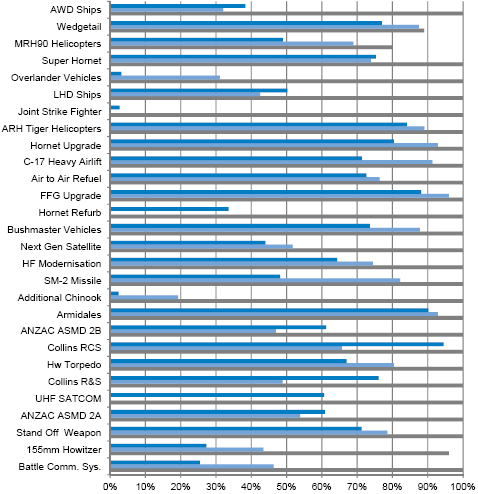
2.4 The first snapshot, Figure 2, provides an overview and sets out the percentage of budgeted cost expended, the percentage of the scheduled time elapsed and the percentage of key capabilities expected to be delivered by the DMO.57 Firstly, the figure shows that, for most projects, the budgeted cost expended is broadly in line with the proportion of time that has elapsed in the project's schedule.58
2.5 The exceptions continue to include the two Collins Class Submarine projects (replacement combat system, and reliability and sustainability enhancements), where most of the materiel has been acquired and expenditure undertaken, but there have been difficulties in obtaining sufficient time in the submarines' full cycle docking program to complete the project.
2.6 Exceptions, where time elapsed is approximately 20 per cent greater than budget expended, include:
• MRH90 Helicopters, where developmental issues delayed schedule;
• Overlander Vehicles, where contracting of major components of capability (Medium/Heavy Capability) have had schedule delay;
• C-17 Heavy Airlift, which has experienced schedule delays in the delivery of long lead spares and the Cargo Compartment Trainer;
• SM-2 Missile, which is anticipating a real cost decrease as a result of cost savings;
• Additional Chinook, where no major milestones have yet been reached under the Foreign Military Sales (FMS) case to trigger payment; and
• Battle Comm. Sys., which is exposed to multiple platform design authorities, adding to schedule delays.
2.7 Figure 2 also shows that the DMO's assessment is that 25 of the 28 projects will deliver all of their key capability requirements. Those not expected to deliver all their key capability requirements include:
• Wedgetail, where the performance of the phased array radar will not meet the specification at final delivery;
• MRH90 Helicopters, where a number of aircraft systems issues are impacting on achieving the required level of aircrew training; and
• 155mm Howitzer, where the Course Correcting Fuze capability is currently not available for sale through the FMS procurement process.
Figure 2
Project snapshot-Budget expended, time elapsed, and key capabilities expected to be delivered by the DMO (percentage)
| ||
|
|
|
 Budget Expended
  Time Elapsed
  Key Capabilities Expected to be Delivered
Source: | 2010-11 Major Projects Report (MPR) and Australian National Audit Office (ANAO) analysis. |
Note 1: | The Joint Strike Fighter and Hornet Refurb projects do not have an FOC date as they do not introduce a new or complete capability. UHF SATCOM does not have an FOC date as one was not defined at government approval. |
Note 2: | The key capability assessment for Wedgetail has been against the Supplies section of the MAA, which lists the equipment to be delivered. |
__________________________________________________________________________________
56 Source 1: The project maturity score comprises a matrix of seven attributes (Cost, Requirements, Technical Understanding, Schedule, Technical Difficulty, Commercial and Operations and Support). The level of maturity that a project reaches at a milestone for each of these attributes is judged by the project manager on a scale of 1-10. Australian National Audit Office, 2008-09 Major Projects Report, p. 55.
Source 2: The maturity score is defined by the DMO as the maturity of a project by way of an objective score based on the project managers' judgement at defined milestones in its capability development and acquisition phases. Australian National Audit Office, 2010-11 Major Projects Report, p. 524. The more accurate the maturity score then the more reliable the estimate of a project's progress and the greater the confidence the project team would have in pursuing outstanding requirements.
57 Source 1: A project's budgeted cost and schedule data is the position as at 30 June 2011, and may differ from originally approved budgets and schedules.
Source 2: As the DMO's assessment of the likelihood of delivering key capabilities involves high levels of uncertainty which may cause actual outcomes to differ materially from that stated in the PDSSs, this data and the DMO's assessment is outside the scope of the ANAO's assurance review for the 2010-11 MPR.
58 A project's budgeted cost expended is accrual based. In cases where pre-payments/committed funds have been made but have not been expensed/amortised (for example, the Super Hornet, AWD Ships, LHD Ships and C-17 Heavy Airlift projects), cash paid by a project will be greater than the percentage of budget expended as shown in Figure 2.