Life to date schedule performance
2.34 Schedule delays increase the overall cost of project delivery as both the DMO and industry staffing and administrative resources are tied up for longer than planned. Schedule delay has also previously had an impact on a project's budget in real terms when project expenditure occurred at a date later than planned. However, the recent move to out turning of the project budgets to their approved FOC date will limit future budget effects of schedule delays, and will place additional pressure on the DMO in relation to funding when schedule slippage occurs.
2.35 Figure 10 presents information on the projects' original and 30 June 2011 forecasts for achieving FOC. The total schedule slippage for the 28 Major Projects to date is expected to be 760 months when compared to the initial prediction when first approved. This slippage represents a 31 per cent increase on the expected schedule since the main investment decision.72 Across the 28 Major Projects, 14 projects have experienced a schedule slippage in expected FOC achievement.
2.36 Assuming soundly-based schedule forecasts, the reasons for schedule slippages can include technical factors such as design problems, industry capacity and capability, difficulties in integrating different systems to achieve the required capability, or emergent work associated with upgrades. In other cases, a project's ability to gain access to the platform can impact on the schedule (for example, the two Collins submarine projects).
2.37 Further analysis performed by the ANAO revealed that the schedule slippage across the Major Projects in the 2010-11 MPR was 390 months for the Initial Operational Capability (IOC) milestone. Of the 13 projects that have experienced, or are reporting an IOC schedule slippage, six projects are reporting a greater FOC schedule slippage, five projects are showing a reduced FOC schedule slippage and for two projects the schedule slippage remains constant. There are also three projects reporting no IOC schedule slippage that are reporting an FOC schedule slippage.
2.38 A closer examination of the reasons for schedule slippage shows the importance of initial assessments of the purchase type, i.e. MOTS, Commercial-Off-The-Shelf (COTS) or Developmental. Instances of misclassification in this respect have resulted in extended schedule slippage for both the Lightweight Torpedo Replacement (which is not included in the MPR) and ARH Tiger Helicopter. As this is an issue for MRH90 Helicopters, it could be expected that this project will also incur additional project slippage if current remediation action is not successful.73
2.39 Project slippage in these areas could effectively introduce a capability gap or require extension to the planned withdrawal date for those platforms being replaced, i.e. the planned withdrawal date for the Sea King helicopter and Black Hawk helicopter fleets include consideration of the introduction of replacement capability.
Figure 10
Projects' original and 30 June 2011 forecast schedule for FOC
|
|
|
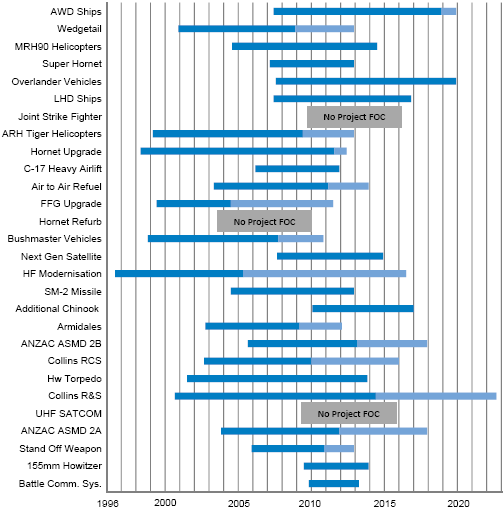
 From Second Pass Approval to Original Forecast
  30 June 2011 Forecast
Source: | 2010-11 MPR. |
Note 1: | Hornet Upgrade FOC date relates to Phase 2.3. |
Note 2: | Bushmaster Vehicles FOC date relates to production period 1. The FOC date for production period 4, which was approved in 2011, is April 2014. |
__________________________________________________________________________________
72 In instances where a Major Project has multiple segments/capabilities with separate FOC dates, the ANAO has used the project's current lead/main capability FOC for calculating schedule performance. The DMO's approach is to use the final FOC date for a project listed in the 2009-10 PDSSs. These approaches, both valid, led to a small difference in the calculated percentage by which the Major Projects' total schedule has slipped for the 2010-11 MPR (ANAO - 31 per cent; DMO - 28 per cent).
73 Further information on MRH90 Helicopters can be found in ANAO Audit Report No.48 2008-09, Planning and Approval of Defence Major Capital Equipment Projects.