Schedule Variance
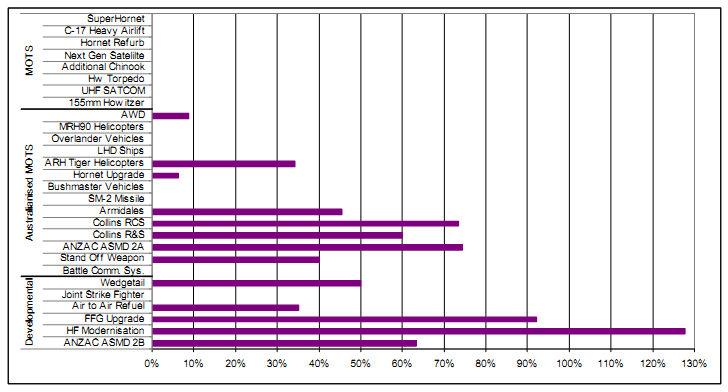
2.29 Figure 2.6 charts the schedule variance as a percentage of the originally estimated project duration from Government approval to FOC. The projects are grouped in the categories of MOTS, Australianised MOTS (AMOTS) and Developmental. The chart shows that, generally, MOTS projects are more likely to deliver on time while AMOTS and Developmental acquisitions are more prone to underestimating technical complexity, platform unavailability and systems integration.
2.30 Anomalies in this chart are:
• Joint Strike Fighter is heavily reliant on the US development program, and anticipates a materiel release in 2017-18. FOC was not formally defined at project approval;
• Hornet Refurbishment, which has no formally defined FOC; and
• UHF SATCOM, which was also approved with no formally defined FOC.
2.31 Although six projects have been added to the MPR program, the projects with schedule variation of 50% or more have not changed from the seven projects reported in the 2009-10 MPR:
• Wedgetail, FFG Upgrade and HF Modernisation and project delays are fundamentally due to an initial underestimation of project complexity. More specifically, the FFG Upgrade issues concerned the complexity of large platform integration; HF Modernisation underestimated the level of effort required to deliver the final system, although the core capability was accepted in 2004; and Wedgetail has faced difficulties integrating the phased array radar and other mission critical elements into an operational system.
• The two Collins projects - Replacement Combat System (RCS) and Reliability and Sustainment (R&S) - have been affected by limited platform availability due to operational requirements and unscheduled maintenance requirements having a negative impact on the Full Cycle Docking program.
• Deferral of FOC for the ANZAC Anti-Ship Missile Defence program (Phases 2A and 2B) has resulted from a Government approved project delivery strategy and scope change to substitute the Very Short Range Air Defence System option with a 'phased array radar' capability; this is a significant capability advantage over the originally approved scope, and allowed leading edge Australian technology to be proven in one ship before committing to the upgrade of the remaining seven ships.
Figure 2.6: Schedule Variance for FOC Since Government Approval, by Project Type
Note: Joint Strike Fighter is currently developmental in nature but should ultimately become MOTS when it enters production line delivery.