Schedule Variance Factor
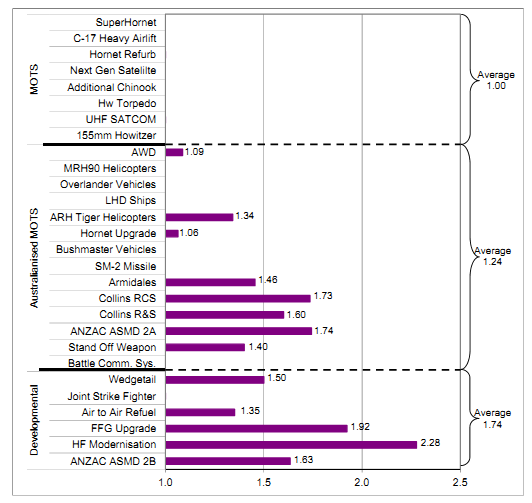
2.37 Figure 2.8 charts the schedule variance as a ratio of the duration of the project as forecast at 30 June 2011 to the originally estimated duration of the project. A 'schedule variance factor' of less than one means the project delivered or is forecast to deliver ahead of the originally estimated schedule. A factor of one means the project has delivered or is forecast to achieve the originally estimated schedule. A factor greater than one means the project has delivered or is forecast to deliver later than originally estimated. Three projects - Joint Strike Fighter, Hornet Refurb and UHF SATCOM - do not have defined FOC dates and were therefore not included in the calculations for analysis of FOC schedule variance.
2.38 Thirteen of the remaining 25 projects in the 2010-11 MPR show a schedule variance factor greater than one, whilst twelve are tracking on schedule. Overall in 2010-11, the average schedule variance across all projects is 1.28, which incorporates an average factor of 1.34 for the 22 repeat projects (in comparison to 1.30 for 2009-10) and 1.0 for five (of six) new projects.
2.39 Detailed information regarding the cause and extent of slippage for each project is contained within the individual PDSS in Part 3; Table 2.4 later in this chapter provides a synopsis of causes for schedule delays.
2.40 The previously mentioned linkage between the three main types of acquisition (MOTS, Australianised MOTS and Developmental) and schedule variance is reinforced in Figure 2.8, where developmental projects show an average variance of 1.74 compared to Australianised MOTS of 1.24 while MOTS are on time, i.e. the higher the degree of systems development/modification and integration, the higher the schedule risk associated with the project. While the analysis indicates schedule slippage, it should be noted that often major capability elements of these projects are already in use by the ADF. For example major capability elements of the HF Modernisation project have been in use since 2004 and similarly the Armidale patrol boats have been in use since 2005.
Figure 2.8: Schedule Variance Factors, by project type
Notes:
1. Joint Strike Fighter is currently developmental in nature but should become MOTS when it enters production line delivery.
2. Joint Strike Fighter, Hornet Refurb and UHF SATCOM were not included in calculation of averages for reasons stated at 2.42.