Incorporating sustainable development in the design process
Successful new development constructed within a high quality built environment is dependent on the concept of the 'sustainable building'. This can be defined as building practices that strive for integral quality (including economic, social and environmental performance) in a broad way. Examples of this approach include: considering the responsible use of natural resources and appropriate management of the building stock that will contribute in the long-term to saving of scarce resources; reducing energy consumption; and improving environmental quality.
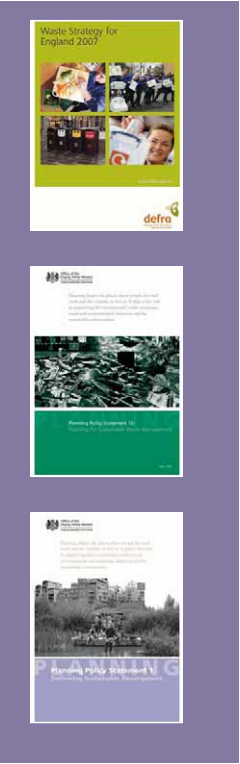
'Planning authorities, developers and other partners in the provision of new development should engage constructively and imaginatively to encourage the delivery of sustainable buildings.' Planning Policy Statement: |
A number of guiding principles have been identified for achieving sustainable development. Key principles for design in the waste sector are:
■ resource efficiency - for example in construction methods and materials
■ energy efficiency, including greenhouse gas emissions reduction
■ pollution prevention, including indoor air quality and noise abatement
■ harmonisation with the environment, including environmental mitigation
■ integrated and systemic approaches, for example an environmental management system.
Sustainable building involves considering the entire life cycle of buildings, taking environmental and functional qualities into account. Good design is synonymous with sustainable construction: no new development can be considered well designed if it does not contribute to environmental, social and economic sustainability.
The waste hierarchy seeks to minimise, reuse and recycle waste (in that order of priority) and can be used as a basis for achieving the objectives associated with sustainable building. When delivering new facilities it is appropriate to consider how the proposal fits with the hierarchy via:
■ the reduction of materials needed for construction through the design of simple low-technology structures and the use of recycled materials where possible
■ considerations to enable the building to be easily decommissioned or reused for a new purpose
■ enabling the future recycling of building fabric for its composite materials.