The design process
The design process is not a fixed, prescriptive set of rules, but should flow with the natural development of a project, from the identification of a need through to the delivery of the final development. The basic design process is applicable to all scales of development but the importance and level of detail will vary with scale. It should not be viewed as a simple linear process, but as an iterative one with various stages that inform the final solution.
The process in outline is relatively simple; a need is defined, which is then worked up in increasing levels of detail until a proposed development can be constructed on the ground. The stages of work set out by the Royal Institute of British Architects (RIBA) provide a useful overview for delivering a new waste facility. These stages are concerned with the mechanics of designing a new development and focus on site specific aspects. They should be used to provide a strategic context for the design of new waste developments.
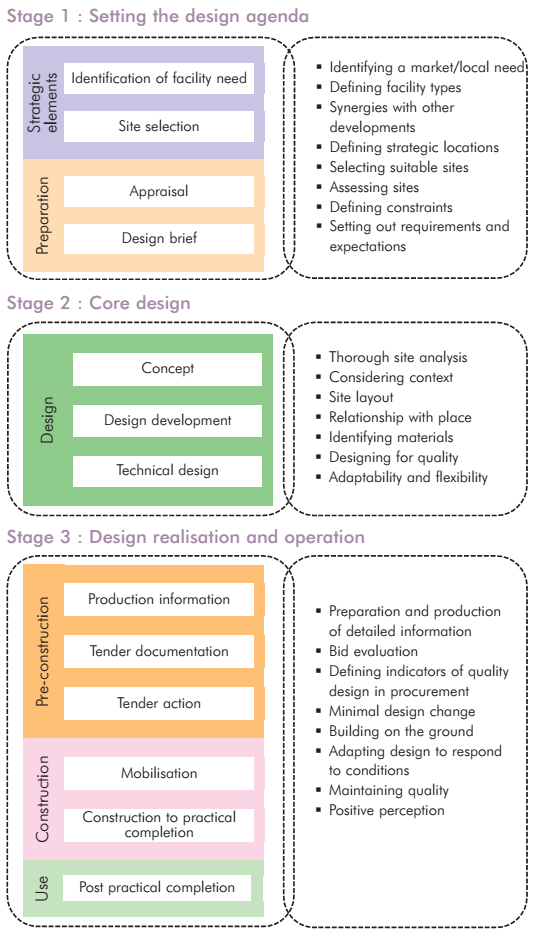
Adapted from RIBA Outline Plan of Work (2007)
Images courtesy of Enviros Consulting and Defra |
There are several key steps in the process of arriving at a solution for a site, each with a greater or lesser emphasis on design.