Site selection
Site selection is a core part of the process for delivering a new waste facility. Planning Policy Statement 10: Planning for Sustainable Waste Management (2005) says planning authorities should identify sites
| 'In their consideration of the environmental performance of proposed development, taking particular account of the climate the development is likely to experience over its expected lifetime, planning authorities should expect new development to: ■ comply with adopted DPD (Development Plan Document) policies on local requirements for decentralised energy supply and for sustainable buildings, unless it can be demonstrated by the applicant, having regard to the type of development involved and its design, that this is not feasible or viable ■ take account of landform, layout, building orientation, massing and landscaping to minimise energy consumption, including maximising cooling and avoiding solar gain in the summer; and, overall, be planned so as to minimise carbon dioxide emissions through giving careful consideration to how all aspects of development form, together with the proposed density and mix of development, support opportunities for decentralised and renewable or low-carbon energy supply ■ deliver a high quality local environment ■ provide public and private open space as appropriate so that it offers accessible choice of shade and shelter, recognising the opportunities for flood storage, wildlife and people provided by multifunctional green spaces ■ give priority to the use of sustainable drainage systems, paying attention to the potential contribution to be gained to water harvesting from impermeable surfaces and encourage layouts that accommodate waste water recycling ■ provide for sustainable waste management ■ create and secure opportunities for sustainable transport in line with PPG13 including through: - the preparation and submission of travel plans - providing for safe and attractive walking and cycling opportunities including, where appropriate, secure cycle parking and changing facilities - an appropriate approach to the provision and management of car parking.' Planning Policy Statement: Planning and Climate Change, |
|
Images courtesy of EGW, Veolia Environmental Services (www.veolia.co.uk) and Enviros Consulting |
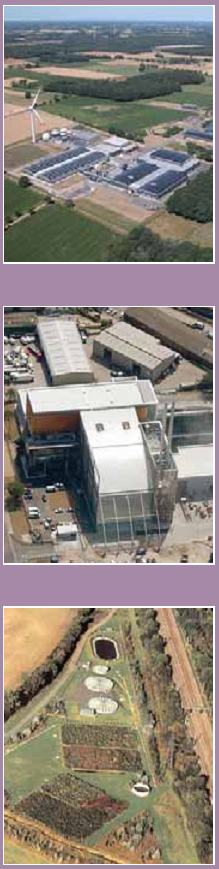
and areas in their development plan documents that are suitable for new or enhanced waste management facilities that will meet the waste management needs of their areas. Elements that need to be evaluated include the relationship with waste arisings, the site area required, site availability and site context. Good site selection is fundamental and many design considerations stem from this core decision.
As well as the strategic and practical decisions around site selection, there are also design and environmental considerations that need to influence the choice. The relevant issues vary greatly with scale and specific operational requirements but, as with all types of development, waste management facilities need to be located sensitively. They need to consider the reaction of the local community and various environmental considerations such as ecological designations. Environmental constraints may inform the site selection process, or have a big influence on the design solution, particularly on key elements such as layout, orientation and even the height of certain structures.
The approach to site selection may vary. There is no prescriptive approach to this but methodologies should have a number of common themes in terms of selection criteria. It is important that the strategies and plans set out clear objectives in terms of design quality and requirements.