ROOF LINES AND STACK DESIGN
The scale of many new waste facilities will require architects to think carefully about how the large mass of the building can be broken up. An imaginative design can assist with its integration into the existing built environment. Consideration should be given to short and long distance views and changing conditions associated with weather or seasons.
Key questions |
■ does the roofline of the proposed facility help to break up its scale and mass? ■ how does the shape of the roof respond to the surroundings? ■ will the roofline complement that of neighbouring buildings? ■ if the proposed facility has a stack how does the design solution for this fit with the other parts of the building? |
The traditional rectilinear forms of many waste 'sheds' is functional and cost effective and often fits well within an industrial setting. However, as is the case when considering size and scale, the setting for many new facilities will often require or deserve more than the most basic minimum cost option.
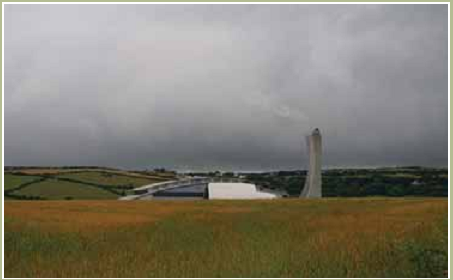
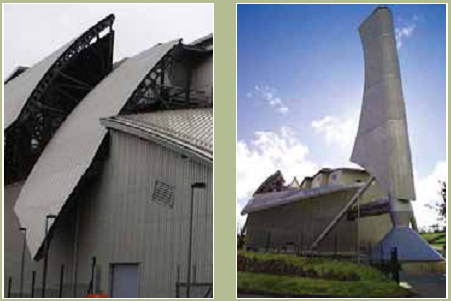
PRINCIPLES IN PRACTICE Richmond Hill, Isle of Man
What is it? ■ Energy from waste facility in a rural setting. Design Features ■ Use of curving roof structures to mimic landform in the countryside setting. ■ Architect inspired Viking ship concept near the coast, with innovative stack design to reflect a sail. ■ Effective use of materials in the design to integrate operational elements with architectural shapes.
|
Proposing the standard simple straight-line solutions may not be enough to respond positively to policy expectations or engender the feeling of quality in design that is required.
Strict adherence with purely functional building forms does not always fit comfortably with the human eye and human perception of what constitutes a 'good place'. The pursuit of good places in design is not purely the domain of urban designers and town planners. The same principles can be applied to waste facilities as to other large urban buildings, offices and civic structures.
Interest can be generated very effectively by simple alterations to the 'basic' design. On a traditional steel portal frame building much can be achieved cost effectively by small alterations to the vertical profile and roof interface. For example, low pitched roofs, simple curves or a stepped roof line can provide the texture that is required. This can break up the mass of the building and provide a more sympathetic profile. More radical solutions, such as curved or flat profiled roofs, may also be considered.
Roofs can be used to improve the overall sustainability credentials of waste facilities, and to provide design interest through features such as:
■ roof lights incorporated to maximise natural light
■ photovoltaic cells
■ collection of rain water ('grey water') for various non-potable uses
■ living/green roofs
■ eye catching use of shape and texture
■ imaginative use of colour and type of roofing materials.
Similar principles apply to stack design. Many new facilities, and in particular energy from waste (EfW) plants are likely to require tall stacks to facilitate effective dispersion of combustion gases. The height will be determined through assessment of a number of factors including local setting, climate and computer modelling of air dispersion characteristics. Computer modelling can also assess the effect of proposed buildings on airflow and this is an important design consideration in terms of the relationship between different elements of the proposed development and any nearby structures.
Stacks associated with waste facilities are often associated with sources of pollution. The reality is that strict European legislation means that potentially harmful emissions from waste facilities can be controlled to levels that are almost negligible and compare favourably with other industries.
Where some architectural treatment can be applied to stacks to fit with the overall design concept this is often helpful in softening the otherwise industrial characteristics of facilities. There are a number of different approaches that can be used to create interest in the form and also deceive the eye through a partial optical illusion making the viewer believe the stack is actually shorter than it is.
Interesting examples of stack design associated with waste management facilities in the UK and in Europe include:
■ Isle Man EfW plant - a sail structure used to integrate with overall plant design concept and reduce the perceived stack height
■ Vienna EfW plant - a distinctive structure and local landmark, with interesting detail that complements the rest of the building
■ Lakeside, Slough EfW plant - external spiral superstructure around simple narrow flues reduces the mass of the stack and adds visual interest
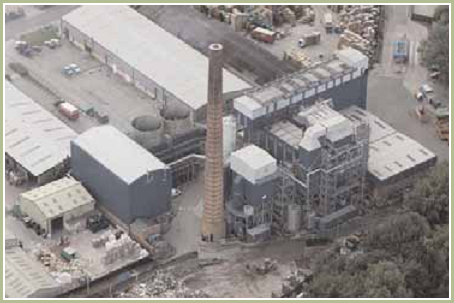
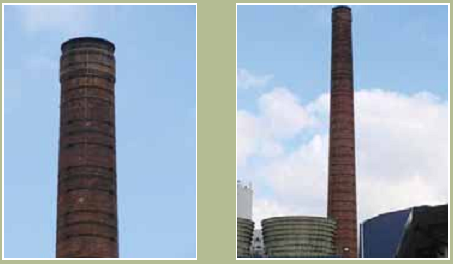
■ Bolton, EfW - a traditional cotton town, a relatively old incinerator (1970 refurbished 1990's), a traditional brick stack has been used to reflect the historical industrial heritage of the area.
PRINCIPLES IN PRACTICE Raikes Lane, Bolton
What is it? ■ Energy from waste in a semi urban setting. Design Features ■ The use of a gently tapering brick stack sets this apart from other facilities. ■ The brick stack reflects the cotton mill industrial heritage of the Bolton skyline at the time the plant was built in 1970 before the height of the steeplejack, Fred Dibnah's, demolition spree!
Images courtesy of Enviros Consulting and Greater Manchester Waste |