LANDSCAPE AND BIODIVERSITY
When designing a new development the setting should be considered from the outset. The design of a facility needs to consider more than just the building footprint or indeed the site in isolation. It is often beneficial if wider site design issues can be included in this process from the outset, which can also set the tone for the ethos of the development as a whole. The space around the building should not be forgotten; the consideration of landscape is integral to design quality. The area around a proposed development can provide great opportunities for providing an appropriate setting as well as enhancing biodiversity.
| Key questions |
| ■ What type of landscape strategy would be appropriate for a site? ■ Can biodiversity gains on the site be realised? ■ Can locally native plant species be incorporated within planting schemes? ■ How can planting be used to help break up hard elements of the development e.g. planting between roads, living roofs? |
An appropriate landscape strategy is an important facet of the whole site design. Often there will be limited opportunities for landscaping, but where they exist they should be grasped. The landscape strategy should be appropriate to the location in which the site sits. It is likely that a very different approach will be taken if a proposed site is set within an urban or industrial context, compared with a rural site. As such soft landscape issues should be considered at the start of the design process. This will avoid landscape design being an afterthought and just being applied to the 'space left over after planning' (Llewelyn-Davies, Urban Design Compendium, 2007).
Landscape architects and designers who have previously applied their expertise to open sites such as landfills need to start from a very different standpoint and design philosophy. Landscape planting schemes associated with quarries and landfills have often been used to screen and indeed hide site operations. To this end, many have been very successful.
With buildings, hiding them is not generally an option. A landscape design strategy that seeks to simply screen a building assumes it is fundamentally unattractive. New buildings should not automatically be seen as a negative. However, in some circumstances minimising potential visual impact may be of paramount importance, and opportunities for screening should be considered even if this is only in relation to certain locations around a site.
The use of appropriate landscape treatment and strategies for sites can bring benefits, both in terms of the appearance of a site and biodiversity gains. Retaining and augmenting existing vegetation on a site can reduce the visual impact associated with a new development, particularly relatively low level elements and manoeuvring vehicles. Fundamentally the landscape strategy should be seen as an opportunity to assist the integration of a new development with its surroundings.
| 'The character and appearance of land, including its shape, form, ecology, natural features, colours and elements and the way these components combine. ....This includes all open space, including its planting, boundaries and treatment.' By Design, Urban Design in the |
The landscape strategy for the site can be seen as a very good opportunity to maximise biodiversity potential. Habitat creation or replacement as part of the landscape proposals can present beneficial opportunities. Any ecological survey work undertaken as part of an Environmental Impact Assessment should be considered when preparing the landscape strategy. The local Biodiversity Action Plan (BAP) should be referred to, as this can provide valuable pointers with regard to habitat creation and suitable species for inclusion in a planting scheme.
On smaller sites chosen to accommodate small single use waste facilities (civic amenity sites, small transfer stations etc) the opportunities for complex landscape strategies are likely to be limited. However, carefully thought out planting at key nodes such as the access points can be very effective if done well. Planting on buildings themselves (including living/green roofs) can also be used to soften facades, naturalise the look of manmade building materials and break up the mass of the structure. Consideration needs to be given to maintenance and access requirements if this approach is chosen.
|
Images courtesy of Enviros Consulting |
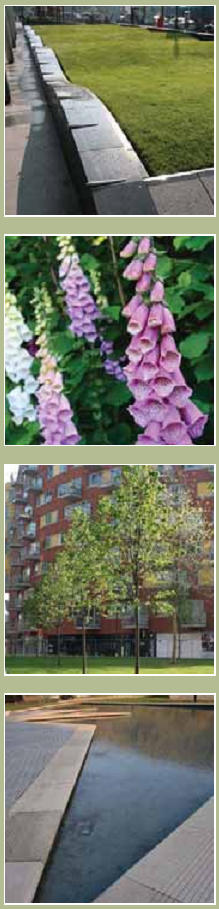
On larger sites, a more complex landscape design strategy is likely to be required. Where there are multiple buildings and different waste activities, landscaped areas can be used to help the overall and layout and flow of the site, providing legibility. Such an approach will be particularly important where there is public access.
In urban design terms the challenge is to use landscape design in a way that helps to provide cohesion and a sense of place; linking buildings, uses and spaces both within the outside the site.
Waste facility designers should share the same ambitions as urban designers as the principles remain the same. The landscape strategy for a site is part of the overall design and is an essential part of creating a good place. It provides opportunities to dispel negative preconceptions about waste facilities as unpleasant places to be and a relatively cost effective way of presenting a more positive image of waste management generally.