Location and orientation
The local climate at the site and the orientation of the building will have an influence on energy and water management and should be a factor when designing the building.
The choice of materials used in construction will affect energy efficiency. For example, using a dark coloured roof cladding in a hot climate will be less energy efficient than choosing a light coloured or reflective finish.
Other factors, such as orienting rooflights to maximise the use of sunlight or incorporating solar water heating or photovoltaics may be relevant.
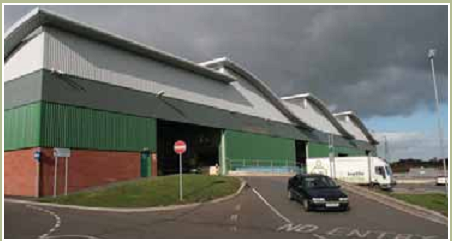
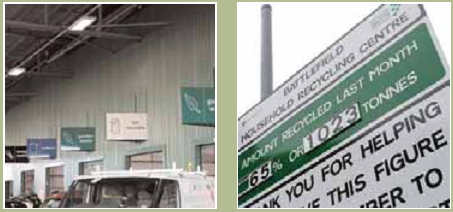
PRINCIPLES IN PRACTICE Battlefield Enterprise Park, Shrewsbury
What is it? ■ Waste recycling centre and transfer station/bulking facility in an urban fringe setting. Design Features ■ Incorporates a number of design features to reduce the impact on the surrounding environment. ■ A ground source heat pump under the car park provides heating for the office building. ■ Underground water storage tanks collect storm water run off to help mitigate potential flooding. ■ Roof lights and opaque panels to maximise natural light. ■ Carefully considered design to fit within an established employment area. ■ Strategic site, designed carefully to allow future expansion.
Images courtesy of Enviros Consulting and Shropshire County Council |
Certain locations may lend themselves to the incorporation of renewable energy technologies. Wind turbines may be suitable in areas with high wind speeds. Equally, solar water heating, photovoltaics or a ground source heat pump may present opportunities. Certain technologies may lend themselves to the incorporation of energy generation or combined heat and power (CHP). With CHP such an approach is likely to be most appropriate where an end user for energy is located in close proximity to the proposed facility. This may influence some of the strategic decisions at the start of the design process.