The Pennsylvania Story
In 2006, Governor Edward G. Rendell convened a Transportation Funding and Reform Commission to assess the state's transportation system. According to the commission's final report, Pennsylvania needs $1.7 billion in additional annual transportation funding to maintain the current system.15 The report recommended that the state make smarter use of existing funds, increase taxes and fees and explore innovative funding mechanisms, including public-private partnerships.
In addition to the $1.7 billion needed annually to support its transportation infrastructure, the state needs more than $14 billion just to complete the maintenance projects it has put off in the past, according to a March 2008 report from the Pew Center on the States' Government Performance Project.16
In spring 2007, the legislature heard testimony about all manner of funding sources but was unable to find common ground, says Craig Shuey, executive director of the Senate Transportation Committee.17 Rising gas prices complicated both the challenges and the solutions; taxpayers were already driving less, and it seemed politically difficult to ask them to pay more at the pump or at tolls. Then Governor Rendell announced his plan to help close the funding gap: lease the Pennsylvania Turnpike for 75 years to the highest bidder, with the notion of investing the money to generate a source of funding to support the state's infrastructure needs.18 Administration officials said they believed other funding options weren't viable. "We looked at tolling of existing interstates. We looked at raising current gas taxes. We looked at adding fees. And basically every way that we were able to think of was money being taken out of the pockets of Pennsylvania citizens to pay for more transportation," Roy Kienitz, Governor Rendell's deputy chief of staff, told legislators in June 2008. "The real attraction to the governor of a lease of the turnpike is that potentially given just an inflationary series of toll increases, by using the power of the market . . . we could bring billions and billions of dollars to transportation investment."19
At the time, support for public-private partnerships, particularly for new construction and expansion projects, had been building in the state Senate. Broad legislation authorizing the use of public-private partnerships appeared poised for easy passage, but opposition to Governor Rendell's turnpike plan stalled that momentum. Lawmakers' concerns centered around the idea of leasing the state's main artery for three-quarters of a century-and that the lease could possibly be made to foreign companies, such as Macquarie, based in Australia, or Abertis, based in Spain.20
SOURCE: Pew Center on the States, 2009
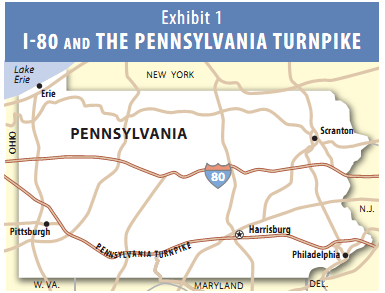
Amid this stalemate, legislators began asking if there might be a way for the Pennsylvania Turnpike-in its current, state-owned-and-operated formation-to play a larger role in generating transportation funding.21 The Turnpike Commission proposed increasing tolls on the turnpike for only the sixth time in its history and ask the Federal Highway Administration for permission to toll I-80, another key cross-state corridor.22 The Turnpike Commission would turn over funds to the Pennsylvania Department of Transportation (PennDOT) for statewide transportation needs-including mass transit, bridge repair and other infrastructure elements that had long lacked reliable funding streams. All told, the proposal, which became known as Act 44, would provide Pennsylvania with $116 billion over a 50-year period if the Federal Highway Administration approved tolling of I-80.23
The ensuing debate over Act 44 exposed a number of geographical and philosophical fault lines. Legislators with districts along the I-80 corridor worried that tolls would divert much of the commercial and out-of-state traffic-and the economic activity it generates-away from rural areas along the corridor.24 Many didn't like the idea of using road money to fund mass transit, a departure from past practice.25 Meanwhile, some legislators in the southeast part of the state, especially those near Philadelphia, were used to driving on toll roads as a part of their daily lives and thought it only fair that I-80-an aging roadway that costs the state $100 million a year to maintain-carry its proverbial weight.26 And the promise of putting in place the first predictable funding stream for the state's ailing mass transit systems was enough to win over many urban legislators.27
Ultimately, Act 44 passed in 2007 as part of a compromise over the state budget.28 But to the chagrin of many Act 44 supporters, the transportation bill didn't end the conversation about how to best fund transportation in Pennsylvania. Says Shuey: "Maybe a week later, the governor said, 'It's not enough money and the feds might not approve I-80 tolling. I want to pursue a turnpike lease.' And right off the bat you've got a reversal of the deal that came together on Act 44."29
Governor Rendell, doubting that the Federal Highway Administration would decide in Pennsylvania's favor, resurrected his plan to lease the turnpike, a process that culminated in a request for qualifications in September 2007.30 Fourteen bidders expressed interest. Reflecting on the deal, administration officials acknowledge that they expected a range of bids from $12 billion to $16 billion.31 But a number of legislators said they believed the bids would be as high as $30 billion.32
Only four bidders, including Citi Infrastructure Investors and the Spanish firm Abertis Infraestructuras, remained during the final months of the process; those two companies ultimately merged their proposals into a single bid and competed against Goldman Sachs and Macquarie/Cintra for the lease.33 When the two highest bidders, Goldman Sachs and Abertis/Citi, submitted bids within 10 percent of each other, the state called them back for a best and final offer round. Abertis/Citi raised additional capital from lending institutions that had been supporting Macquarie/Cintra and increased its bid by more than $2 billion in the final round.34
Exhibit 2 |
Pennsylvania policy makers have long sought sustainable sources of revenue to support the state's growing infrastructure needs. In recent years, two competing plans have generated contentious debate. One would lease the Pennsylvania Turnpike to a private consortium in exchange for a large, upfront payment, while the other would toll I-80, another key east-west route across the state, with permission from the Federal Highway Administration (FHWA).
SOURCE: Pew Center on the States, 2009 |
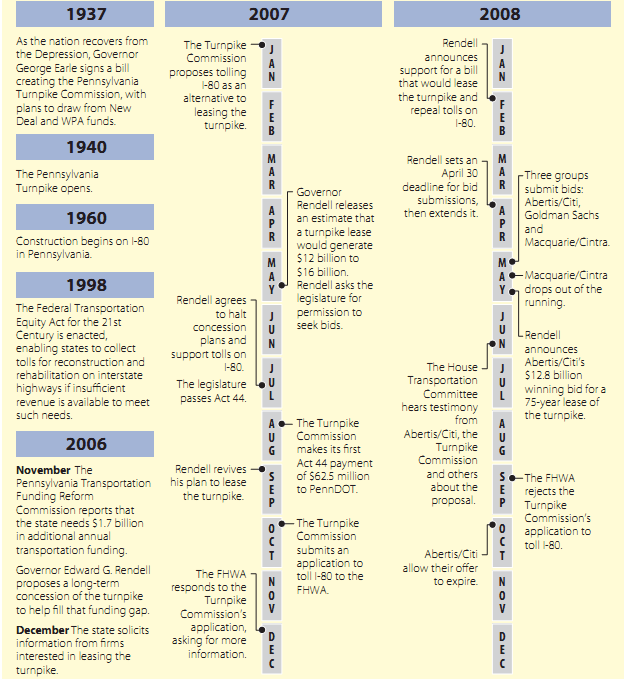
Abertis/Citi's winning bid of $12.8 billion was announced in May 2008. Because some of this cash would have been used to pay off turnpike debt, the final amount that Pennsylvania could invest to generate funding for infrastructure needs would have been about $10.2 billion.35 The Abertis/Citi group intended to raise tolls on the turnpike to pay for the lease. According to terms set by the state, the private operator could have raised tolls on the turnpike annually by 2.5 percent or the Consumer Price Index, whichever was greater.36 Under the agreement, Abertis/Citi would have paid for improvements to the road, including installation of fiber optics to detect accidents and new toll-collection technologies.
Meanwhile, under Act 44, the Turnpike Commission had begun making payments to PennDOT.37 The Commission paid $750 million to PennDOT in 2008 and is scheduled to provide an additional $850 million in 2009 and $900 million in 2010.38 The Commission is relying heavily on debt to make its payments in the near term, until toll increases-and I-80 tolling, if it is ultimately approved-improve its balance sheet.39 Under Act 44, a 25 percent toll increase went into effect on January 4, 2009, with 3 percent increases scheduled every year thereafter.
Against this backdrop, Governor Rendell asked the legislature to approve Abertis/Citi's $12.8 billion offer. The ensuing months of debate over the turnpike lease proposal were followed closely by the public and the press, and organizations favoring and opposing the concession produced reports to support their claims. Legislators were besieged with information and input from lobbyists, research organizations, media and constituents. "There was fuzzy math; there was misinformation; and there was pure spin," says Representative Rick Geist, Republican co-chair of the House Transportation Committee and a proponent of the deal. "The misinformation was almost to the point that people thought the Spaniards were going to take the highway and move it back to Spain."40 Legislative debate became stuck around several factors, including the state's financial assumptions and the proposed oversight mechanism, which would have left monitoring of the private operator to a three-member board composed of the governor, the transportation secretary and the budget secretary. When the legislature failed to vote on the proposal by the end of September 2008, the consortium withdrew its bid.41
At nearly the same time the proposed lease failed to move forward, the Federal Highway Administration rejected the state's proposal to toll I-80. The agency required that tolls be used to meet legitimate operations costs for the highway itself; the requested tolls would have supported both roads and transit in Pennsylvania.42 The state may choose to resubmit its request to President Obama's Department of Transportation, but unless it receives a warmer reception there, the $946 million average annual expected funding that Act 44 was supposed to generate over the next 10 years will drop to $450 million.43
What happens next? Policy makers in Pennsylvania are closely watching the new Obama administration, both to determine the likelihood that tolls on I-80 will be approved and to see how the state's transportation funding
"We need a mosaic of funding sources. We're one bridge failing away from a major crisis." |
Rep. Joe Markosek, |
outlook will be affected by the federal stimulus package. With less than $30 billion dedicated through the stimulus to highway improvements, many state officials' optimism about a significant improvement in highway conditions has been tempered.44 Major federal transportation funding legislation is also due to be reauthorized this year, and policy makers in Pennsylvania and other states are watching to see how that may affect their needs. Pennsylvania leaders are likely to wait for signals from Washington, D.C., before taking dramatic action to address their challenges, but state legislators say that all options must be on the table.45 "We need a mosaic of funding sources," says Representative Joe Markosek, Democratic chair of the House Transportation Committee and an opponent of the lease. "We're one bridge failing away from a major crisis."