Differences between PPP Projects
However, for purposes of cost effectiveness evaluation, there are structural differences between PPP projects and projects that are wholly publicly funded that may warrant different treatment. For projects that are fully funded by the government, the only cost effectiveness assessment that will be done is that provided by the government. Thus, there is good reason for the government to conduct a rigorous evaluation of ridership and revenue to ensure that the transit agency fully understands the financial viability of the project. On the other hand, for PPP projects where the private partner commits to a substantial investment in the project and will be at risk financially for project performance, it is reasonable to assume that the private partner has done considerable financial testing and evaluation before deciding to become a partner on the project. Because it has "skin in the game," the private partner will protect itself by doing its own due diligence.
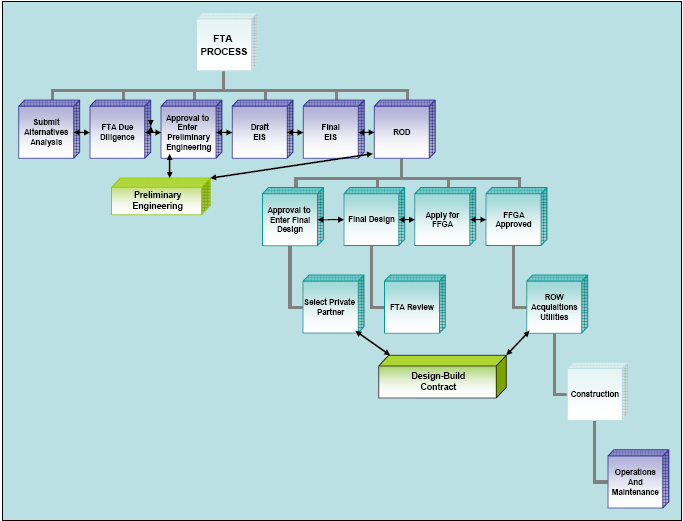
Exhibit 4.4 illustrates how the New Starts process could be adjusted to accommodate PPPs using a design-build project delivery approach. As shown in the exhibit, preliminary engineering is allowed to begin during preparation of the environmental clearance documents, with hiring of the design-build contractor to begin the final design following receipt of the ROD for the project from FTA.
Exhibit 4.3: Potential FTA PPP Process for Large-Scale Transit Capital Projects
Source: Nossaman Guthner Knox & Elliott LLP, February 2007.