6. Global PPP Financing or Delivery of Road Projects by Contract Type
Several types of contracting arrangements are used around the world to finance and delivery highway-related infrastructure projects, including roads, bridges, and tunnels. The PWF database lists the various contracting approaches used or proposed for each project. These contracting approaches generally fell into the following seven categories:
• Build-Operate-Transfer/Build-Transfer-Operate (BOT/BTO) - this is a project delivery method typically involving the design, construction, finance, and operation of a facility whereby the contract team acquires ownership of the facility until the end of the construction period or the contract term, at which time ownership of the facility is returned to the original public sector sponsor.
• Build-Own-Operate (BOO) - this is a project delivery method similar to BOT whereby the contract team both owns and operates the facility.
• Concession - this is a contract arrangement which grants the contract team full responsibility to finance, build, operate, and/or maintain the facility as a
franchisee for a specified period of time, whereby the private sector team takes most of the project and financial risks and potential rewards for the term of the Concession contract. In some cases, Concessions have been granted for the operation and maintenance of facilities built by others, as a comprehensive form of Management Contract.
• Design-Build (DB) -the contract team is responsible for both the design and
construction phases of a project as part of a single contract. This is in contrast to the traditional project delivery approach used for highway projects in the United States, Design-Bid-Build (DBB), in which the design firm and the construction contractor are separately responsible for the design and construction phases of a project. Design-build contracts typically do not involve the use of private financing. However, they are still considered PPP projects because of the added responsibility and risk assumed by the private sector Design-Build team.
• Design-Build-Operate-Maintain (DBOM) - the contract team is responsible for design, construction, operation, and maintenance of the facility for a specified period of time, whereby payment beyond project completion is predicated on meeting certain prescribed performance standards relating to physical condition, capacity, congestion, and/or ride quality. This is an extension of Design-Build that provides an inherent incentive for the design-builder to provide a better quality plan and project by creating a lifecycle responsibility and accountability for the performance of the facility by the design-builder.
• Design-Build-Finance-Operate (DBFO) - this is an extension of the DBOM
project delivery method in which the contract team is also responsible for
financing the project and takes the risks of project financing during the contract
term. This contract approach is similar to BOT/BTO becomes a Concession
when the private sector team acts as a franchisee with most of the project and
financial risks and potential rewards.
• Management Contract - this is a contract arrangement under which the contract team manages the provision of specified functions at certain performance standards over a set period of time, often with the provision of subsequent time extensions to the contract. Like Design-Build, these contracts typically do not involve the use of private financing but do represent additional responsibilities and risks for the private sector asset management team.
In addition to the above terms, two more contracting approaches are noted in the PWF database. These include:
• Asset Sale - when the facility is sold to a private sector team which holds full
responsibility and liability for the project and its risks and returns. There are very few true Asset Sales involving highway-related facilities and so this contracting approach is included in the Concession category defined above.
• Joint Development Agreement (JDA) - this is a contract arrangement whereby both the public sector sponsor and the private sector contract team enter into a joint agreement to share responsibilities for developing, financing, operating, and preserving the facility. This contract approach is used where there is a strong interest by the sponsoring agency to retain a substantial portion of control over the project and interest in the proceeds of the project. For the purposes of this report, JDA contracts are included in the Concession category defined above.
Several of these contracting approaches are closely related and are sometimes used interchangeably in the PWF database, even for the same project. Those contracting approaches that most closely related to the description of the project and its financing approach were used to characterize the road projects according to contracting approach. As shown in Exhibit 10 below, the different contracting approaches combine various phases of the project life cycle. What makes them all part of the family of public-private partnerships is the sharing of roles, responsibilities, risks and rewards between the public and private members of the partnership.
Exhibit 10 - Alternative Contractual Arrangements for Delivering Highway Infrastructure*
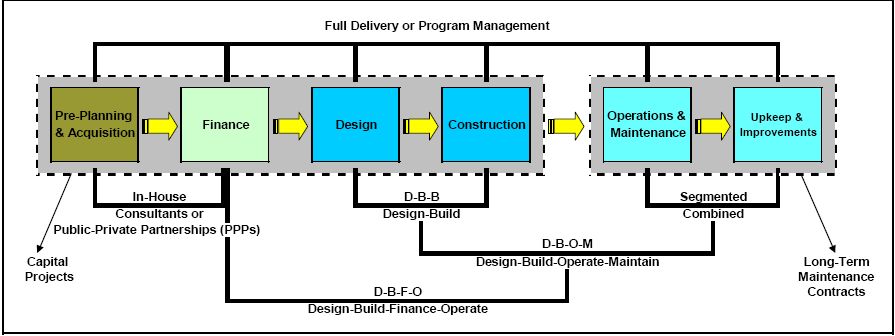
* Based on a scheme developed by Pekka Pakkala. Innovative Project Delivery Methods for Infrastructure -An International Perspective. Finnish Road Enterprise, Helsinki, 2002, p. 32.
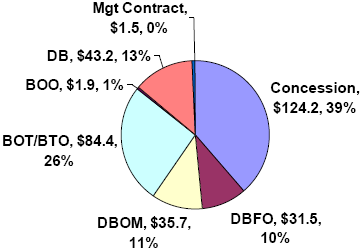
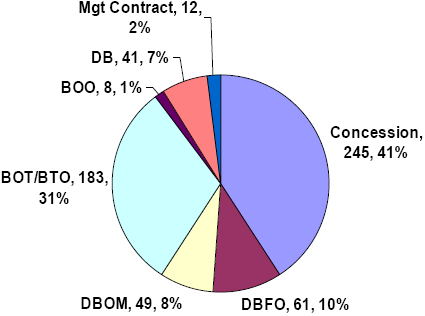
On a worldwide basis, the breakdown of highway-related infrastructure projects financed through PPP arrangements by contract type is shown in Exhibit 11. When eliminating projects that have not specified a budget or clearly defined a contract type, the PWF database contains 599 highway-related projects worldwide, representing $322 billion since 1985.
On a worldwide basis, the predominant contracting approaches (shown in bolded text) are: Concession and BOT/BTO. Each of these contract approaches places a high degree of responsibility and accountability on the private sector team, with the public sector sponsor serving primarily as a contract administrator. All line functions are included in the contract scope, and maximum flexibility is provided to the contract team to develop the project in the most cost-effective manner. This is in sharp contrast to the traditional Design-Bid-Build approach to delivering highway projects in the United States. Under DBB, the public sponsor is much more involved in all phases of the project, often uses prescriptive specifications, and is ultimately responsible for the results of the design process.
Exhibit 11 - Worldwide Road Projects Planned or Completed since 1985 by Contract Type
| Contract Type | Number | Percent | $ Billion | Percent | $B/Project |
| Concession | 245 | 41% | $124.2 | 39% | $0,507 |
| 61 | 10% | $31.5 | 10% | $0,516 | |
| 49 | 8% | $35.7 | 11% | $0,728 | |
| 183 | 31% | $34.4 | 26% | $0,461 | |
| 8 | 1% | $1.9 | 1% | $0,239 | |
| 41 | 7% | $43.2 | 13% | $1,054 | |
| Mgt Contract | 12 | 2% | $1.5 | 0% | $0,127 |
| Total | 599 | 100% | $322.4 | 100% | $0,538 |
Overall, the most prominent contracting approach for delivering highway-related PPP projects is a Concession, with about a 40 percent share (as shown in Exhibit 11). Second is BOT/BTO at just over a quarter share of the total project costs. Many Concession projects are set up as DBFO or DBOM contracts. When combined, these three related contract types comprise a 60 percent share of the value of highway-related PPP projects. The more limited contracting approaches, DB and Management Contracts, represent significantly smaller portions of the PPP project total. The contract approaches with the largest average project cost are DB and DBOM, respectively.
The distribution of PPP road projects financed since 1985 by contract approach is shown in Exhibit 12 on the next page, in terms of the number of projects and the cost of these projects. These exhibits clearly demonstrate the predominant role Concession contracting plays in highway-related project development and financing.
Exhibit 12 - Distribution of Worldwide Road Projects Planned or Completed since 1985 by Contract Type
| (Projects)
|
| ($ Billions)
|