Findings
The PPP and outsourcing models are clearly the most effective methods of large project procurement although it needs to be remembered that neither are appropriate for all projects. PPPs are a better procurement option when the state is delivering services that can benefit from risk transfer, the certainty of lifecycle costing, and the integration of design and construct services, an output specification (innovation, new technology) and efficient management. The model is based on an ex ante evaluation of procurement methods which does not capture ex post improvements in service delivery. However, a number of studies in Britain and Australia in recent years point to the significant benefits in health, education and justice user outcomes from services delivered by PPP, BOOT and alliance contracting methods that are not being achieved with the traditional model.
Two further findings were identified in this comparative analysis. The first is the important role that incentive plays in procurement outcomes. The three most effective methods of project procurement are those that create a strong incentive for private performance over the life of the contract. In this context, incentive operates at two levels -the alignment of contractor payment mechanisms to delivery performance and creation of mechanism that create a high marginal return on investment for private investors. The top three performers in this comparison scored highly in the evaluation areas of certainty (lifecycle costing), private investment and strong private incentive.
Diagram 2 Weighted Procurement Effectiveness Results
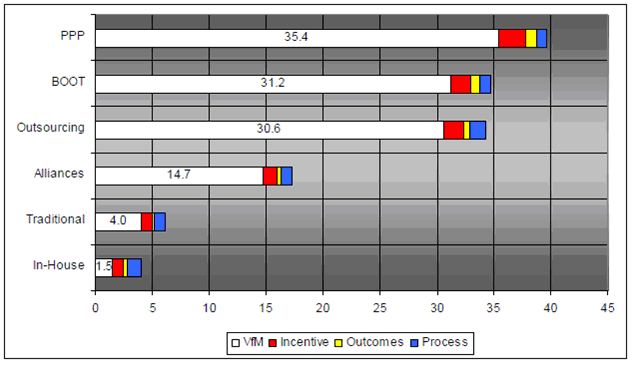
The second finding is the strong association between qualitative procurement outcomes and the use of output as opposed to input service specifications. The evidence for this association has only recently come to light and follows 15 years of broader procurement experience in the United Kingdom and Australia. It also requires new approaches to the measurement of government service delivery and outcomes which are now being implemented such as user surveys and public value (Moore 1995). Both of these relationships are the object of further research activity at the School in 2009.
NOTE
The references for this document are available from the author at