2.3.3 Observations
It is expected for standard projects to have smaller optimism bias levels when compared to non-standard projects and this is the case for the buildings project type. However, for civil engineering projects, the study shows a higher works duration optimism bias for standard projects as opposed to non-standard projects. The standard civil engineering project type mainly comprises of road projects, which tend to be susceptible to environmental impacts, giving rise to high works duration optimism bias in the study.
The Mott MacDonald study showed that the optimism bias levels for traditionally procured projects (at strategic outline case and full business case) were higher than for PFI projects (at full business case). This difference is attributed to the negotiated transfer of project risks from the public sector to the private sector, where project risks are passed to the party best placed to manage them consistent with achieving value for money and quality. However, the high level of diligence demanded by PFI procurement to establish the business case, was not observed for traditional procurement and may have contributed to the inadequacy of the traditional project business cases used in the study. For PFI projects, the project requirements are more clearly defined and a longer relationship is developed with the potential contractor and service provider, and the client, thus allowing potential problems to be resolved early.
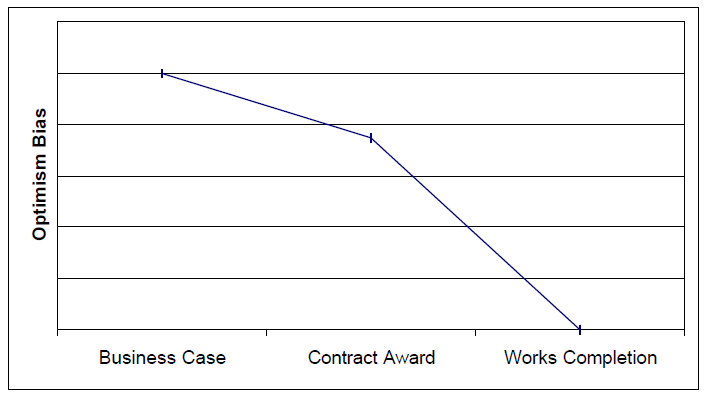
The study also showed that the optimism bias for a project decreases through its project life-cycle as shown in Figure 3. As the project progresses, ideally the strategies for risk mitigation and management would be in place and the potential occurrence of certain project risk areas is likely to decrease with time (e.g. at the business case stage, obtaining planning permission is still uncertain while during construction, planning permission should have already been obtained and so the risk of not obtaining planning permission is no longer an issue. However, all conditional issues associated with planning permission still need to be addressed.).
Figure 3 Typical Optimism Bias during Project Life-Cycle
Therefore it is not surprising that the optimism bias levels in Table 3 for PFI / PPP projects are much lower than that for traditionally procured projects since more project risks are identified and mitigated at the full business case stage than at the strategic outline case and the outline business case stages.
Equipment and development projects, procured traditionally and/or through PFI, recorded high works duration, capital expenditure and unitary payments optimism bias levels. The optimism bias levels recorded during the study are within expected values, based on Mott MacDonald's experience of equipment and development projects, even though the exceptionally high capital expenditure optimism bias for traditionally procured equipment and development projects was greatly affected by a single project. These projects recorded high optimism bias levels as project requirements and scope tends to be harder to define as opposed to construction type projects. The project requirements tend to be less tangible. The geographical and technological aspects of the projects add further complications. An information technology development project could potentially cover several geographical locations locally or internationally. Each additional site could have different technological requirements or systems (e.g. communication technology in the UK is different from that in the USA). If critical project risks within such projects are not effectively managed, then these exceptionally high optimism bias levels are likely to occur.