2.4.3 Observations
The tables of results in Appendix F give an indication of project risk areas most likely to cause overruns if sufficient risk mitigation strategies are not put in place. The top eleven project risk areas contributing to the recorded capital expenditure optimism bias are listed below in descending magnitude according to the maximum average percentage contribution recorded across the project types.
1. Inadequacy of the business case (58%)
2. Environmental impact (19%)
3. Disputes and claims (16%)
4. Economic (13%)
5. Late contractor involvement in design (12%)
6. Complexity of contract structure (11%)
7. Legislation (7%)
8. Degree of innovation (7%)
9. Poor contractor capabilities (6%)
10. Project management team (4%)
11. Poor project intelligence (4%).
All other project risk areas contributed less than 3% to the measured optimism bias. Based on Mott MacDonald's experience in other projects outside the study, the following project risk areas have also been known to contribute to optimism bias:
1. Design complexity
2. Information management
3. Technology
4. Site characteristics
5. Public relations.
The study showed that most of the traditionally procured projects in the sample were inadequately defined (in terms of requirements and project scope) in the approved business case and that minimal attention had been given to benefits and operating costs in the short, medium and long term. On the other hand, PFI / PPP procurement requires the projects to be defined around their benefits/requirements and not just project deliverables. Adopting this approach of defining a project based on its benefits may help ensure full delivery of benefits on traditional projects. All project business cases need to be based on correct and reliable project intelligence (e.g. reliable information about ground conditions).
The study recorded a gestation period for PFI projects twice as long as that for traditional procurement, mainly due to the complexity of the contract structure. In addition, a large proportion of the PFI projects reviewed were the first of their kind to be procured in this fashion (e.g. the first PFI road, prison, hospital). No precedent or guidelines had been set to aid the procurement process up to contract award. However, despite this initial delay, approximately half of the PFI projects studied were delivered and ready for use on time. The other half of the projects ran to project construction programmes but overall project programmes were delayed due to long gestation periods, resulting in the late delivery of benefits.
An interesting observation from Table 3 is the minimal difference in optimism bias between the standard and non-standard civil engineering projects. This is a reflection of the very nature of civil engineering, which is heavily influenced by the effect of ground conditions, the associated uncertainty, and the fact that its risk has traditionally been retained by the public sector. In addition the standard civil engineering project type optimism bias has been strongly influenced by a single project impacted by a major environmental issue.
In most instances, the inadequacy of the business case was stated to be the major cause of project time and cost overruns. It may also be argued that the third most significant project risk area, disputes and claims, is also a result of inadequate specification giving rise to variations and consequently claims. This fundamentally demonstrates the need to concentrate significant effort and diligence to ensure the business case comprehensively represents the real requirements of all project stakeholders, in terms of the agreed project scope and objectives.
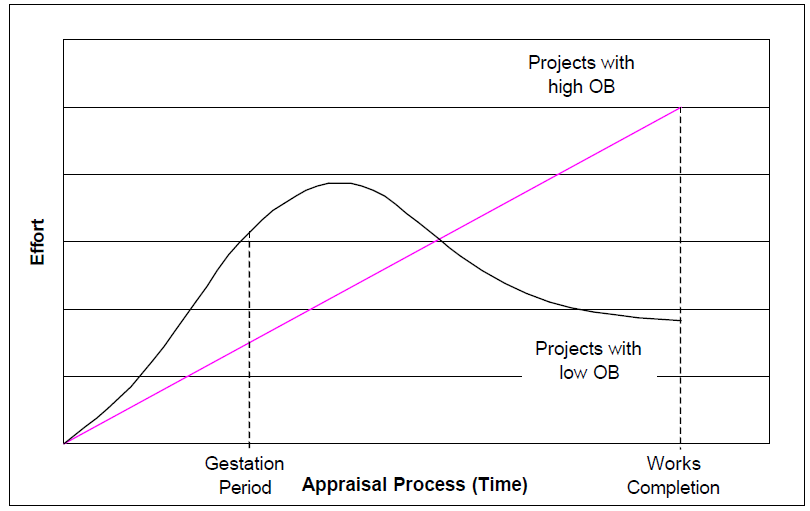
Figure 4 illustrates the observed relationship between project team member effort and the resultant optimism bias. This shows that early effort spent managing project risks tends to result in low optimism bias.
Figure 4 Relationship between Optimism Bias and Effort
When preparing business cases, project sponsors should be looking to the future, both medium and long term (i.e. including provisions for whole lifecycle replacement and updates in the technological basis of projects). Especially as the study recorded changes in legislation and technology as the two most consistent external project risk areas contributing to high optimism bias. Good project intelligence is essential when preparing a business case. However, it is difficult to completely address all possible changes outside the project constraints i.e. external project risk areas.
An area of potential benefits shortfall is where the need for the services provided as a result of the project changes with time, effectively stranding the investment. This risk is increased where projects have unexpectedly long gestation periods and can be mitigated through scenario analysis at initial definition stage. Insufficient data was available to allow this area to be analysed in any detail.