3.3.3 Risk Management
Risks can be managed by the application of recognised strategies to manage project risk areas. Expending more effort in developing the business case, identifying and clarifying stakeholders' requirements, obtaining confirmation of the requirements, analysing risks when evaluating options and, where appropriate, modifying required benefits to reduce risk should result in fewer problems later in the project life-cycle, paving the way for smoother project delivery.
When performing a project appraisal, note that:
• Only competent experienced appraisers who thoroughly understand the issues and risks associated with the project should perform its project appraisal.
• Business cases should also address project risk areas that have not had a negative influence on optimism bias levels
• The optimism bias should be fully assessed in line with the appraisal date, because the risk profile for a project will change during its project life-cycle
• The study showed conclusively that the single most important contributing factor to optimism bias was the inadequacy of the business case
• Implementing risk management strategies may come at a cost and, therefore, each management strategy must be financially worthwhile. When developing the business case, minimise the total cost of managing residual risks and implementing risk management strategies. Figure 5 shows an example of the change in project costs arising from risk mitigation and managing residual risks during the project life-cycle of traditional projects if effective risk management is in place (this concept is relevant for all projects, including PFI / PPP projects).
Figure 5 Relationship between Cost of Risk Mitigation and Cost of Managing Residual Optimism Bias
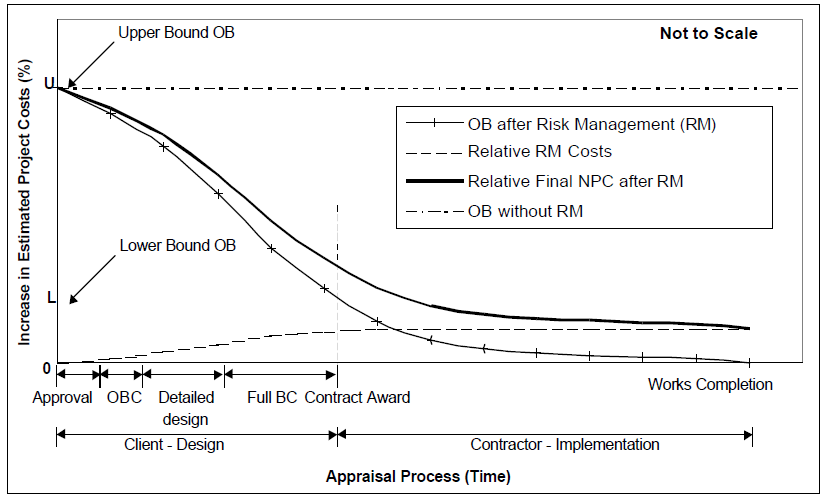
Where upper bound optimism bias represents the optimism bias level to expect for a project without effective risk management and the lower bound represents the optimism bias level to expect with effective risk management by the time of contract award. See Section 4 for guidance on how to use upper and lower bound values when calculating optimism bias levels for current projects.
The management of successful projects has shown that appropriate emphasis should be applied to reviewing the project objectives, scope, specifications and definitions detailed in the business case to ensure that they are fully comprehensive and address the whole requirements of the project in the short, medium and long term. Effective risk management, scope definition and change management (including stakeholder management and communications management) all play important roles in project delivery. These management tools are further discussed in Appendix H.
Note that there may be a cost (i.e. cost for managing project risks including risk mitigation and risk occurrence) associated with reducing optimism in project estimates. For example if the scope of works for a project is not fully defined in its business case at the outset capital costs may increase as the business case is further refined and a more robust scope definition is prepared. Perform a review of project estimates when major changes are made to a project's scope to check whether the project estimates are still relevant.