H.7 Purchasing Decision-making Process
During the procurement and implementation of a project, a balance between value to the project (i.e. contribution to the successful delivery of project benefits) and cost has to be achieved through a decision-making process. The objective should be to deliver the best value for the money spent. There currently is a tendency to rely solely on cost (i.e. choosing the cheapest option without considering the value to the project of the item/service purchased). The following figure describes the relationship between the value to a project of an item/service purchased and the relative cost to the project.
Figure 7 Relationship between Value to Project of Item/Service Purchased and Relative Cost to Project
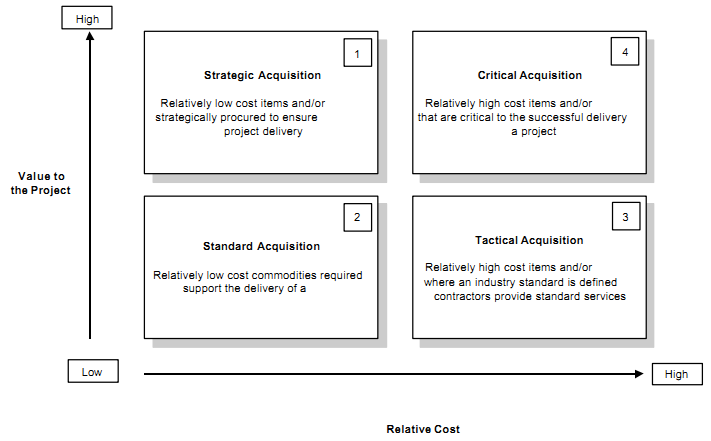
Items/services that have high value to the project should not be purchased on price alone. Their value to the project should be strongly emphasised. These purchases and decisions have been classified as 'Strategic Acquisition' and 'Critical Acquisition' in the figure. 'Standard Acquisition' and 'Tactical Acquisition' do not have high impacts on the successful delivery of the project and so consideration based on cost will be more acceptable. Examples of the four different types of acquisitions are:
1. Strategic Acquisition (e.g. project managers, key consultants and advisors)
2. Standard Acquisition (e.g. office consumables and secondary consultants not involved in key decision making processes)
3. Tactical Acquisition (e.g. bulk resources and general contractors)
4. Critical Acquisition (e.g. specialist contractors and suppliers)