3.1. Procurement timescales
| The mean time taken to procure PPP projects was 28 months, which is generally perceived to be slower than non-PPP procurement. |
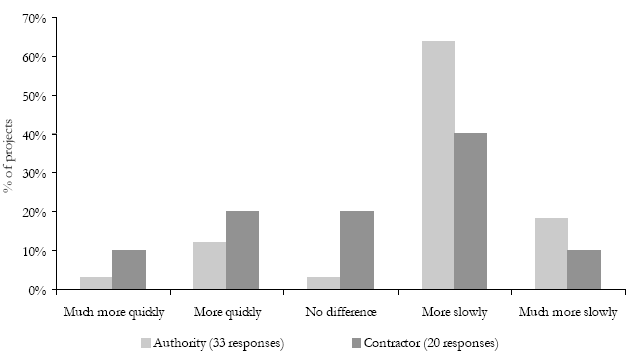
The mean time taken to procure the PPP projects included in the survey (i.e. the time from issue of the OJEU notice to financial close) was 28 months. Most authorities thought that PPP procurement was slower than alternative methods. Most contractors also perceived PPP procurement to be slower, although 20 percent of contractors believed that there was no difference from conventional procurement. The differing responses from authorities and contractors may reflect the fact that authorities commit a considerable amount of time to developing PPP projects in the period after issuing the OJEU notice, but before detailed bids are invited from contractors.
Figure 3: Are PPP projects procured more quickly or more slowly than non-PPP projects?
The length of time taken to develop a project from the initial strategic planning stage through to the agreement of a contract with the private sector affects the speed with which new public services are delivered, and the short-term costs accruing to both the public and private sectors.
One of the main benefits of PPP has been the discipline imposed on the public sector to specify its requirements clearly and up-front. Detailed design work carried out during the procurement phase of PPP projects often would have been included in the construction phase of conventionally procured projects. Although a short procurement process is desirable, bringing design work forward at the expense of increasing the procurement period is not necessarily a bad thing.
The involvement of lenders in PPP contracts generally results in more due diligence being carried out during the procurement phase than is the case for conventional procurement, and this increases the time taken. Similarly, longer contract lengths for PPP projects (typically 20 to 30 years) mean that both public and private sectors invest more time up-front to ensure that the contract meets their requirements and allocates risks appropriately.