5.3. Performance monitoring
PPP contracts should set out how performance will be monitored, based on output measures.
Performance monitoring mechanisms are satisfactory but improvements could be made to performance indicators. |
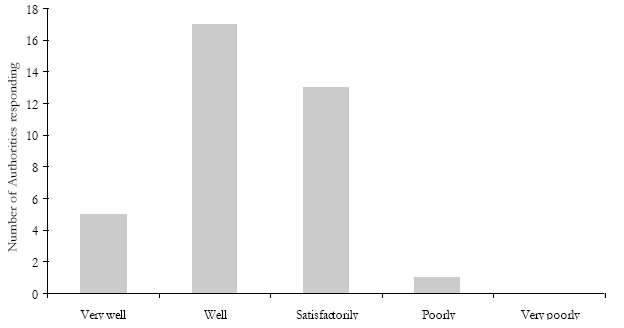
61 percent of authorities thought that performance monitoring mechanisms were working well or better, 36 percent thought that they were satisfactory, and only 3 percent thought that they were poor (see Figure 15 below). These results are very similar to the NAO's findings in its 2001 report 'Managing the Relationship'.
Figure 15: How are project and performance monitoring mechanisms working?
Only 45 percent of authorities thought that the performance indicators were wholly appropriate for measuring contractor performance. 52 percent thought that they were partially appropriate and 3 percent found that they were not at all appropriate. Despite this lack of satisfaction with the performance indicators, there were only a few projects where new indicators had been negotiated. This could be due to the lack of contract flexibility or, equally, to the lack of better alternatives.
Based on our interviews, it appeared that performance indicators (KPIs) worked best in sectors such as prisons, transport and water where there were clear KPIs for the whole sector, not just PPP projects. Arguably, these sectors also have less complex interfaces between the contractor, public sector staff and systems and users. Interviewees in other sectors commented that interpretation of the drafting of performance indicators was often open to discussion. This issue of ambiguity was exacerbated by changes of staff. In some cases interviewees felt that too many indicators were monitored, not all of which were useful.
Some authorities reported that it was difficult to establish the right balance between monitoring and auditing. Several stated that they had not fully understood their monitoring requirements at the outset of the contract. They were concerned that, given the impact of the payment regime, leaving the contractor to self-monitor would discourage him from being proactive in identifying and rectifying faults.
Several authorities commented that they were surprised at the input required on their part to ensure that the contractor delivered the contracted level of service. PPP contracts are typically self-monitoring, with the authority responsible for auditing the contractor's records of service failures. One interviewee commented that, while mistakes in the self-monitoring invariably had to be put down to human error, the mistakes were skewed in the contractor's favour.
Authorities commented that the ultimate threat of default did work to encourage good performance.
Recommendation: There is a strong case for establishing, for each sector, a relatively short list of performance indicators, enabling comparison between PPP and non-PPP projects. A framework of benchmarking actual performance against periodically restated KPIs and enhanced authority rights to re-tender the contract in the event of persistent shortfalls against KPIs could considerably improve outcomes in the longer term.