TESTING THE WATERS: Public Opinion on Systemic Reform
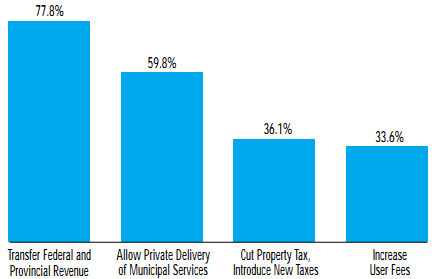
The Canada West Foundation's Looking West 2003 survey provides valuable insights on how the public might respond to a variety of the options discussed above (Berdahl 2003). The data indicate that western Canadians are not equally receptive to all of the various financing options. For example, support is highest for transferring federal and provincial tax dollars to local governments. Almost 80% of western Canadians support this idea (Figure 16). Private delivery of some municipal services is the second most popular option with almost 60% of western Canadians in favour. However, support for tax shifting, that is, cutting property taxes and introducing new local taxes, was quite low. Support for increasing user fees was the least popular alternative. Simply put, while western Canadians may feel that their municipal governments need more revenue, they are not highly receptive to many of the options for generating that revenue.
| FIGURE 16: Support for General Local Finance Options | ||
| QUESTION: | Please indicate if you would strongly support, somewhat support, somewhat oppose, or strongly oppose each of the following revenue options. For each, assume that the option would result in no increase in total taxation, but rather, a change in how current tax revenues are raised. | |
|
SOURCE: Berdahl, Loleen. 2003. Looking West 2003: A Survey of Western Canadians. | ||
|
| ||
| QUESTION: | To conserve water, governments should charge [industries and citizens] the full cost of the water they use. | |
|
SOURCE: Berdahl, Loleen. 2003. Looking West 2003: A Survey of Western Canadians. | ||
|
| ||
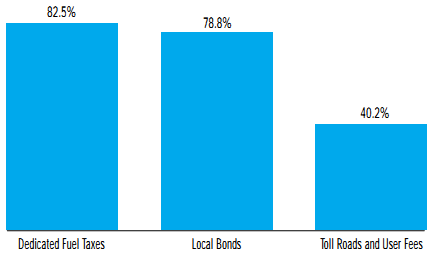
| QUESTION: | As governments look to how they are going to pay for transportation infrastructure in the years ahead, how would you view the following financing options? | |
|
SOURCE: Berdahl, Loleen. 2003. Looking West 2003: A Survey of Western Canadians. | ||
|
| ||
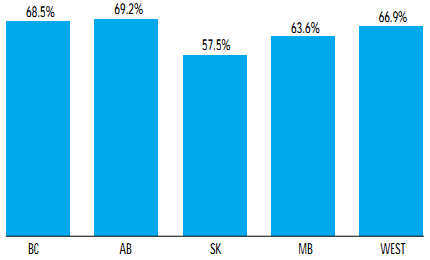
| QUESTION: As [province's] cities grow in population, efforts should be made to reduce urban sprawl.
SOURCE: Berdahl, Loleen. 2003. Looking West 2003: A Survey of Western Canadians. | ||
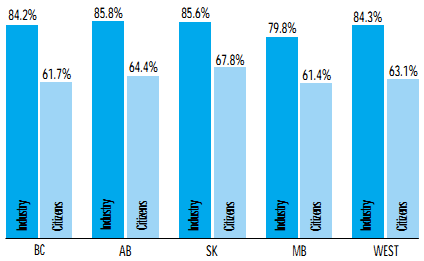
The public may, however, be receptive to increasing prices on certain services, particularly if the motivation goes beyond mere financial concerns. For example, over six in ten western Canadians support charging citizens the full cost of water in order to conserve the resource (Figure 17). Over eight in ten support charging industry the full cost. These mixed findings suggest that the public may be open to increased user fees, but that support varies according to the service being considered.
The Looking West survey also asked western Canadians to comment about a number of specific financing options for transportation infrastructure (Figure 18). The option of a dedicated fuel tax received considerable support. This high level of support is noteworthy, particularly given recent musings and public statements concerning a potential sharing of federal fuel tax revenues with cities. Support was also high for "allowing Canadians to personally invest in local infrastructure projects by buying stocks or bonds." Support dropped dramatically, however, when it came to the question of using toll roads or other user fee models to finance transportation systems.
There is one final option to explore. This alternative is not a specific financing tool for addressing infrastructure, but one that has no small impact - reducing urban sprawl. If the physical footprint of cities can be reduced, then the need to lay out large sums for infrastructure can be lowered. In general, western Canadians are quite supportive of reducing sprawl. Almost two-thirds of all western Canadians in the Looking West survey favoured this policy (Figure 19). Support was highest in Alberta, the one western province currently experiencing the most population growth. Support was also quite strong in British Columbia, but less so in Saskatchewan and Manitoba. The interesting irony here, of course, is the low levels of support registered for specific options such as increased user fees and road tolls that could go a long way in helping combat sprawl.
SUMMARY: The state of public opinion presents governments with a significant hurdle in pursuing systemic reform. While it is not entirely clear how these hurdles can be overcome, attempts are being made. The Federation of Canadian Municipalities (FCM) recently launched its "Bridging the Gap" initiative, which is a grassroots advocacy campaign designed to capture the attention of individual Canadians to the importance of rebuilding roads, bridges, and transportation systems. A similar initiative entitled "Sustaining Prosperity Together" is also underway at the Alberta Urban Municipalities Association (AUMA). Such efforts will have to continue if public opinion on the importance of municipal fiscal reform is to move forward.