ONTARIO
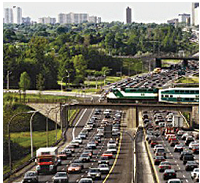
Given its population size, economic output, and reliance on U.S. markets, Ontario's transportation priorities will be consistent over the next decades: 1) to ensure that the transportation system improves Canada's economic competitiveness and contributes to a high quality of life; 2) to maintain efficient economic corridors and border crossings for trade; 3) to encourage the use of public transit to deal with road congestion in large urban centres; and 4) to ensure safety and security in the transportation system. Some of Ontario's most significant challenges will come in its most populous and growing areas. Southern Ontario, including the greater Toronto area, will grow from its current population of almost eight million to more than 12 million over the next two decades. The number of jobs in this region will grow to 5.6 million. At the same time, the region will continue to be a major destination for tourists. Congestion is already a serious problem in large urban centres and at border crossings, causing increased commute times, lost productivity, higher costs for doing business, and environmental damage. Congestion will increase unless concrete actions are taken immediately. In order to address growth pressures in urban areas, coordinated, long-term land use and transportation planning is required to appropriately integrate future transportation investments with growth. Ontario has recently taken several measures in this direction, including the Places to Grow Act and the Greenbelt Act. These pieces of legislation set a framework to focus population growth and employment in order to support the efficient use of existing and future transit, highway, and other infrastructure investments. A high priority is to connect all of Ontario's cities to international markets along economic corridors leading to border crossings. South central Ontario, in particular, is both the origin and destination of a large percentage of Canada's freight traffic. Canada's busiest border crossings are located at Windsor, Niagara, and Sarnia, which together carry over 56% of Canada's road trade with the U.S. Efficient border crossings in Ontario are a national imperative, not only for the volume of trade generated within the province, but also for the trade from Atlantic Canada and Quebec that passes through Ontario to U.S. destinations. New investment in infrastructure is urgently needed. For many years, governments at all levels have neglected this critical element in our society, and that neglect is now apparent to all. To begin to meet current pressures, Ontario has adopted a $30 billion, five-year infrastructure investment plan entitled ReNew Ontario. Transportation figures prominently in the plan. Ontario will tackle the growth and congestion challenge by making strategic investments of $11.4 billion to reduce commute times, increase transit ridership, and improve efficiency and capacity at border crossings and on strategic economic corridors. That provincial investment will have to be matched by other levels of government and the private sector. Innovative and integrated transportation planning and investment are critical to Ontario's economic performance in the coming decade. Getting it right in Ontario will also have a significant impact on the success of a national transportation strategy and on Canada's future economic prospects. |
|