TD Economics Special Report
|
| TD Economics Special Report May 20, 2004 |

After a quarter century of under-investment, Canada's system of public infrastructure is in need of major repair and upgrade. But, while this fact has been well recognized by policymakers across the country over the past few years, and reflected in a corresponding rebound in capital outlays since the late 1990s, momentum to take action already appears to be losing muscle. Notably, after a few better years on the fiscal front, governments are once again facing a tightening financial noose. And, in this competitive environment, infrastructure almost certainly loses out to other areas of government funding. Meanwhile, Canada's infrastructure pothole continues to deepen.
The jury remains out on whether the current setback will prove to be temporary or something longer lasting. On the plus side, tough measures to reduce deficits taken this year by provincial and territorial governments - who are important players in the provision of infrastructure - will certainly help to enhance their medium-term fiscal flexibility. At the same time, however, there is a real risk that Canada will ultimately fall further behind in addressing its infrastructure challenges. A 20-year track record on deferring and delaying capital investment is one good cause for concern. Even more importantly, with no end in sight to the continual upward pressure on health-care costs, the battle for scarce public resources is unlikely to let up.
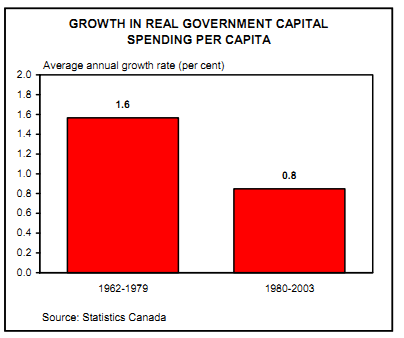
Although the negative impacts of a deficient infrastructure are only starting to mount - and become visible to Canadians on a day-to-day basis - we believe that an ongoing neglect of the nation's stock of `public capital represents one of the greatest risks to the country's overall quality of life. Notably, with the state of a region's infrastructure weighing more heavily on location decisions of highly-mobile businesses and individuals, a deteriorating capital stock will increasingly cut into gains in productivity and living standards. But, the potential impacts do not stop there. Without an excellent system of public assets such as transit systems, water and sewer systems and hospitals, it will become more difficult to ensure that the health, safety, and security of the region's residents will be protected.
While the cost required to bring Canada's infrastructure up to scratch and to support future growth will be hotly debated, one thing is for sure - the figure exceeds what most governments could viably foot under the status-quo. As such, a shift in the overall approach to infrastructure provision will be necessary, with strategies more heavily grounded in raising efficiency, equity and accountability within the system. As we spell out in Part H of this report, not only will this entail an increased tilt towards a user-pay model - where appropriate - but a better match between revenue-raising flexibility and responsibilities at the municipal level of government. Lastly, while much of the infrastructure provision falls on the plates of the local and provincial governments, we see the need for both the private sector and federal government to take on increased roles.