Local governments number one infrastructure provider
Regardless, the Statistics Canada figures are useful. Not only does their definition encompass most of the assets that we're interested in, but the data are rich in detail. Sifting through the figures, a number of interesting facts leap off the page:
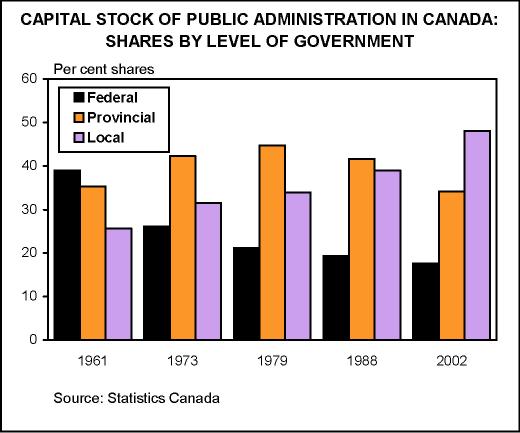
• Local governments are the largest stakeholder on the public-infrastructure landscape, holding more than half of the total assets, followed by the provinces and territories, at two-fifths. Although the federal government holds 17 per cent of all public capital stock, this largely reflects a major stake in buildings and machinery and equipment. In contrast, the federal share of public infrastructure is about 7 per cent.
• At both the provincial and local levels, transportation infrastructure leads the way in terms of importance. More specifically, provinces have responsibility for highways, while the local governments have jurisdiction over local streets and rural roads, which represent about 90 per cent of Canada's 1.4-million-kilometre combined road and highway network.3
Moreover, a look back over history also provides some eye-opening results:
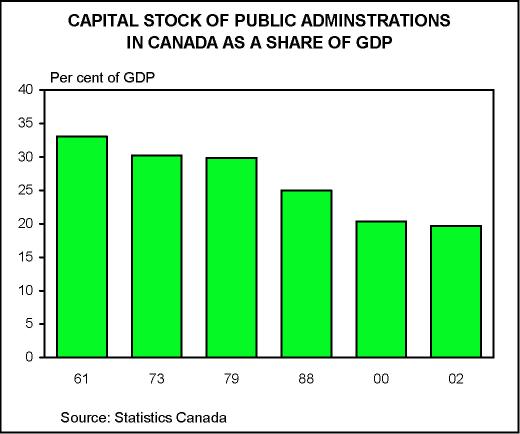
• In aggregate, the growth in value of public infrastructure assets in Canada has been significantly lagging behind the economy as a whole. In fact, after rising to 23 per cent in the mid-1970s, public infrastructure as a share of GDP slumped to 16 per cent by 2001.
• Nor has public investment kept up with private investment. Over the past three decades, the ratio of public infrastructure capital has slipped in Canada relative to the overall capital stock from 8.1 per cent to 5.5 per cent in 2001, while business sector capital stock has remained steady at 38 per cent.
• At a mere 0.6 per cent in the 1990s, the rate of productivity growth of public infrastructure capital was roughly half the pace recorded in both the 1970s and 1980s.
• Across jurisdictions, local governments have become relatively more important in the provision of infrastructure. Notably, local infrastructure as a share of the total has increased from 35 per cent to 52 per cent over the past three decades, while the federal and provincial shares have dropped by 8 and 9 percentage points, respectively. In fact, local governments are the only jurisdiction to have held their infrastructure shares of both GDP and private investment capital relatively steady since the early 1970s.