How big is the infrastructure gap?
No matter how you slice it, the stock of public infrastructure capital has been in a state of decline over the past few decades. It is not that Canadian governments have been reducing the level of cash outlays for public infrastructure. In fact, total annual public capital spending, which includes amounts earmarked for buildings and machinery and equipment, has been ramped up from $1.3 billion in the early 1960s to $ 18 billion in 2002 ($3 billion in 1961$), while outlays for civil engineering works have risen over the same period from about $1 billion per year in the early 1960s to about $9 billion ($1.4 billion in 1961 $). It is that these amounts have not been enough to offset the effects of wear and tear as well as growth in the economy and population.
Less clear, however, is the extent of the shortfall - or so-called "infrastructure gap" - which represents the backlog of deferred maintenance, rehabilitation and replacement of public assets. Another way of looking at the infrastructure gap is the accumulated annual deficit between the amount needed to properly maintain or replace existing infrastructure as well as to support growth with the amount actually spent.4
Over the past few years, there have been a number of attempts at estimating the size of the infrastructure gap in Canada. When reviewing these estimates, however, certain caveats should be kept in mind. For one, attaching an amount to "needs" is a highly subjective exercise. Yet, most are developed mechanically - either through surveys or through historical spending behaviour - without incorporating issues such as technological innovation and changing government regulations and standards, which would ultimately alter the needed investments substantially. Moreover, the estimates of needs do not factor in the tradeoffs involved, such as higher taxes, user fees or alternative use of the money. Another word of caution is that some of these estimates are sector-specific, while others consider the gap at the municipal level only. Lastly, some look in the rear-view mirror, while others include estimates of future needs. As such, it is hardly surprising that estimates are all over the map:
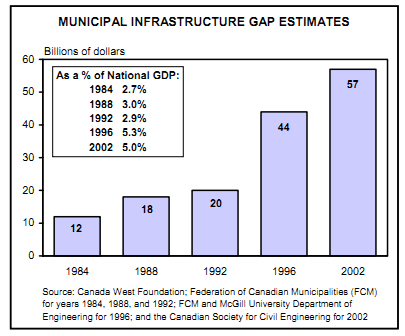
• The most widely cited estimate of the infrastructure gap has come from the surveys undertaken by the Federation of Canadian Municipalities (FCM) in conjunction with the Canadian Society of Civil Engineering. Since 1984, surveys have revealed a gap that has increased from $ 12 billion in 1984 to $57 billion in 2002. Moreover, the Society forecasts an increase in the accumulated shortfall to $110 billion by 2027.5
• In an October 2003 report, the Canada West Foundation used a number of methodologies to estimate the total gap in Canada at $44 billion-$125 billion.6
• In 2003, Saeed Mirza and Murtaza Haider of McGill University estimated the existing infrastructure gap of all levels of government at $125 billion - a figure they say could reach as high as $400 billion by 2020.7
• A study sponsored by CMHC and the Canadian Water and Wastewater Association revealed that the gap for water and sewer would grow to $88.5 billion by 2012.8
• In 1997, the Council of Ministers Responsible for Transportation and Highway Safety estimated that the infrastructure gap for Canada's highways was $ 17.4 billion.9
• The Public Policy Forum estimated a backlog of deferred maintenance at $83.1 billion across highways, colleges and universities, and defense.10
• The Canadian Association of University Business Officers estimated that the accumulated deferred maintenance incurred nationally by universities amounted to approximately $3.6 billion in fiscal 2000-01. When all three types of capital costs (accumulated deferred maintenance, ongoing maintenance and expansion of physical plant) are considered, universities will likely face, over the next 10 years, additional annual expenditures ranging between $1.4 billion and $1.9 billion to accommodate projected growth.11
• The Canadian Urban Transit Association estimates that the infrastructure requirements for the country's conventional urban transit systems is around $13.6 billion.12
• The Conference Board of Canada estimates that the infrastructure gap for sewers, aqueducts, and road systems for Quebec municipalities is between $15.0 billion and $17.9 billion.13
• In a recent speech, Ontario's Minister of Public Infrastructure estimated the province's infrastructure gap at $100 billion.14
• If the value of public infrastructure had stayed at 23 per cent of GDP instead of falling to 16 per cent, $85 billion more in capital spending would have been required.
• If the value of public infrastructure had remained at 8.1 per cent of total capital stock instead of declining to 5.5 per cent, $65 billion more in capital spending would have been needed.
In sum, despite the challenges in measuring the infrastructure gap, the consensus is that the gap is massive - as high as $125 billion or 6-10 times annual investment flows - broadly-based across sectors and levels of government, and likely to head even higher down the road.