The range of options is considerable
While most government activities are operated in public hands, partnering with the private sector is not a new concept in Canada - in fact, jurisdictions at all levels have increasingly turned to "contracting out" the delivery of public services to the private sector over the past decade. However, as the accompanying chart reveals, this form of P3 represents only one step along a continuum that extends from commissioning a private-sector group to design and build infrastructure to one whereby the project is designed, built, financed and operated (DBFO). And, in our view, it is in the upper part of the spectrum - and notably the DBFO approach - where Canadian governments have only begun to scratch the surface in exploiting infrastructure opportunities.
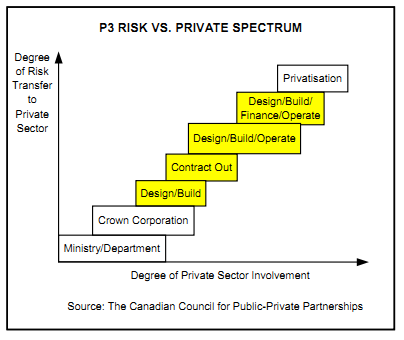
Even though governments have traditionally turned a blind eye to more sophisticated P3s in Canada, this is starting to change, as the demand for infrastructure outstrips the ability of governments to finance and maintain capital projects. Around the country, there are a number of high-profile P3 projects already put in place or on the table -including P.EJ.'s Confederation Bridge, a state-of-the-art water treatment facility in New Brunswick, and B.C. 's Sea-to-Sky Highway to name a few. But, Canadian governments remain in the early stage of the learning curve, particularly when stacked up against the United Kingdom, continental Europe and Australia. It is this country's relative inexperience with P3s and the resulting lack of public understanding of them that remains the number-one roadblock in the way of more widespread use of this model.