Annex 3 Better Leveraging the Benefits of Public-Private Partnerships
Public-private partnerships (P3s) reflect a cooperative venture between the government and the private sector with the purpose of delivering a clearly defined need to the public. At the core, P3s provide a means for governments to capitalize on the expertise, innovation and technology of private firms and, at the same time, download some of the risks inherent in the development of a project or in the delivery of a service. In addition, P3s can provide the government with upfront access to a deep pool of funds, without which necessary projects may remain a distant dream. Naturally, nothing is free and the government must financially compensate the private sector not only for its capital costs, but also for the risks it has incurred. This means that the trick to any well-structured P3 is in identifying the risks that are best borne by each party. As an example, in the construction of a major new highway the managerial and technological expertise of a private firm may lower the risks associated with the design and construction costs, whereas the testing and monitoring of appropriate environmental and safety standards might be more efficiently managed in the hands of the government. P3s come in all shapes and sizes, the most common reflect some combination in which the private sector will design, build, finance and/or operate (DBFO) a public infrastructure or service. The most familiar forms of P3s are in basic infrastructure needs such as water, waste management, energy supply and transportation, however, increasingly their use is extending into public services such as hospitals, schools, government accommodation, defense and prisons.
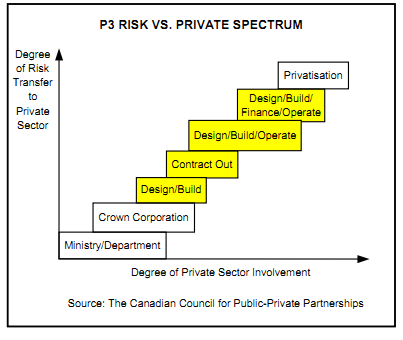
- P3s not a smokescreen for privatisation
- P3s used only sporadically in Canada
- The government's central role
- Four pillars to successful P3s
- Risk evaluation - a critical first step
- Wanted: Contract negotiation and risk analysis expertise in public sector
- Accountability and transparency walk hand-in-hand
- Stronger foundation = fewer barriers
- Overcoming the financing myth of P3s
- P3 value extends beyond financing
- Getting it right with P3s
- P3s hold water with water/waste management
- Energy sparks P3 interest
- P3s without borders
- P3s not a panacea