Part Two Planning and implementing personnel change
2.1 This section of the report examines how effectively the Department has planned and implemented its headcount reduction.
2.2 The Department has steadily reduced its headcount over the past 20 years with reductions of 37 per cent in trained military personnel and 51 per cent in civilian personnel. The Department aims to further reduce its headcount by approximately 25,000 military and 29,000 civilian personnel by 2015. There will be more reductions up to 2020. The Department has not reduced headcount on this scale since the early 1990's during the 'Options for Change' programme after the end of the Cold War.
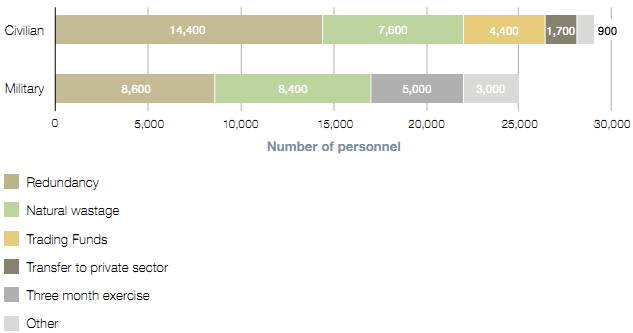
2.3 There are two main ways to reduce headcount: reduce the intake of personnel; and increase the numbers of people leaving, through natural wastage or redundancy. The Department's headcount reduction programme plans to use all these options for civilian and military personnel to differing degrees (see Figure 3 overleaf). A reduction of 4,400 personnel in Trading Funds is also expected, however, we have not included the Trading Funds' actions in this report as they are undertaking this work separately from the Department.5
2.4 Both of the above approaches to reduce headcount have implications for the age profile of the Department. Recruitment tends to bring in younger employees. This is particularly the case for military recruitment. Data for the civil service generally for 2010-11 indicates that older employees (aged 50 and over) are more likely to leave under paid voluntary terms than younger counterparts, potentially leaving a workforce with fewer experienced employees. This will be difficult to control for the civilian workforce as, to ensure equality, the Department is unable to discriminate against certain groups in its selection criteria. However, the military have mitigated this impact to a certain extent by stipulating the ranks, which are intrinsically linked to age, that are to be lost through headcount reduction. As Figure 4 on page 17 shows, the age profile after the first tranche of military redundancies remains largely unchanged.
| Figure 3 How the Department plans to reduce headcount 2011 -15
NOTES 1 As a result of the three month exercise the Army is expected to reduce by a further 5,000 personnel and the Department has yet to determine the detail of how it will achieve this reduction. 2 The "other" category for the military workforce includes the 2,000 personnel reduction the RAF committed to make before the Strategic Defence and Security Review and 1,000 which is a mix of rounding and adjustment of the Army baseline to 2011. 3 The "other" category in the civilian workforce includes the 900 reduction through natural wastage in the Department's wider civilian workforce for example Locally Engaged staff and Royal Navy Auxiliary. 4 Civilian numbers are based on Full Time Equivalents. 5 These figures were correct at the time of publication. Source: Figures provided by the Department |
___________________________________________________________________
5 A Trading Fund is a financing framework for government operations that is not seen as central to government processes. The fund can usually manage its financial affairs more freely than if its costs are met by its parent Department.