Military
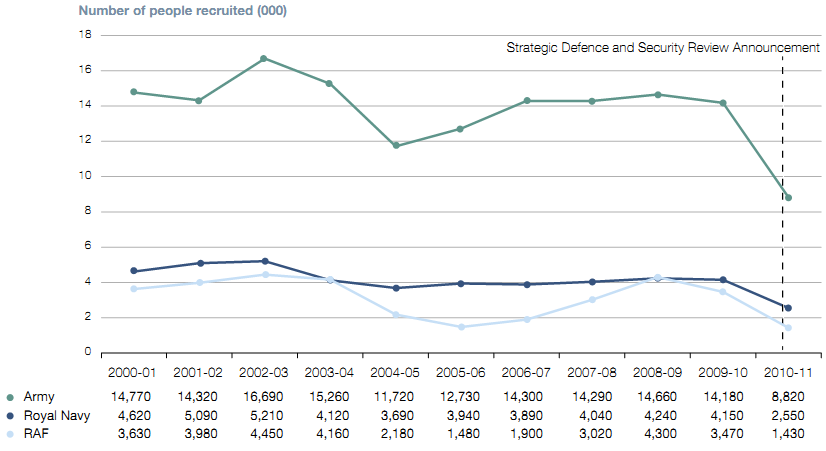
2.22 The Department aims to reduce military headcount by at least 8,400 through natural wastage and reduced recruitment by 2015 (Figure 3) which is 34 per cent of its overall target of 25,000 headcount reductions. The military have substantially reduced but not ceased recruitment. Stopping recruitment previously led to serious skills gaps in trades such as submariners from which the military is still recovering. The recruitment reduction is the biggest influence on declining personnel numbers before redundancy takes effect. As shown in Figure 6 on page 24, recruitment has nearly halved from 21,800 in 2009-10 to 12,800 in 2010-11. The numbers of trained personnel leaving the military have increased by 14 per cent from 12,280 in 2009-10 to 13,950 in 2010-11. The majority of people leaving in 2010 to 2011 left 'voluntarily' - before the end of their contract; or when their employment contract expired (time expiry).
2.23 While the Department has successfully reduced recruitment, the steady outflow of civilian staff and moderate increase in military staff leaving voluntarily were not sufficient for the Department to rely on natural wastage alone to make reductions in headcount on the scale needed. Therefore, the Department decided that some form of redundancy programme was required.
Figure 5 Reasons for civilians leaving the Department
NOTE 1 These data are of numbers of personnel rather than full time equivalents and is based on a representative selection of time periods. Source: Data provided by the Defence Analytical and Statistical Agency |
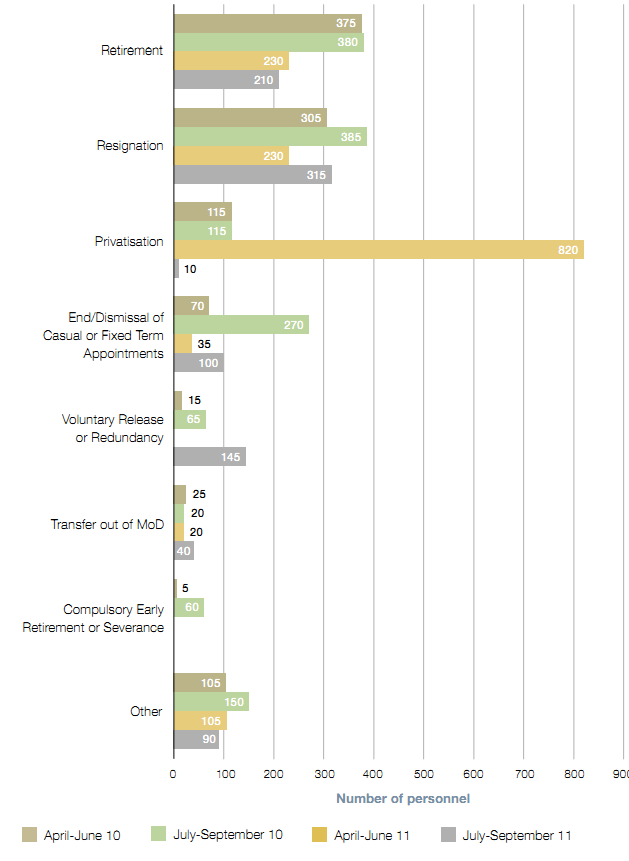
Figure 6 Annual recruitment into the Services
Source: Annual UK Defence Statistics 2011, 2009, 2008, 2007, 2005, 2004 |