Retaining skills for the new Departmental operating model
3.22 The Department is undergoing wider reform as part of the Defence Transformation Agenda including developing a new operating model. The model aims to achieve a simpler, leaner organisation and be a more effective way of running the Department through:
• strengthening financial management;
• strengthening decision-making and individual accountability;
• enhancing the joint delivery of military operations;
• improving the delivery of support services; and
• more effective use of military and civilian personnel.
Figure 9 Managing skills shortages in submariners Having sufficient numbers of suitably qualified submariners is crucial to deliver the continuous at-sea deterrent. However, there are a number of challenges faced in maintaining the right level of staffing: • Long training time and limited pool of potential personnel. It takes in excess of 12 years of training and development for some more senior personnel; and personnel also need to meet the demanding physical and mental fitness standards. • Unfavourable working conditions: separation, isolation, long periods at sea with, in some cases, almost no outside communication, demanding work and only short periods of time for rest and relaxation. There is a shortfall in the number of Officers and Senior Ratings, in certain sub-specialisations. Impact of headcount reductions Submariners' on-board posts are protected from headcount reductions, but their on-shore posts are not. The loss of shore-based posts could impact the balance between time spent at sea and on-shore thus worsening already difficult working conditions. Measures the Royal Navy is taking to improve recruitment and retention Recruitment: • The Royal Navy continues to prioritise submarine recruiting in areas of shortage and a televised recruitment campaign is in progress. Retention: Trying to increase the numbers of individuals volunteering to the Submarine Service from within the Royal Navy. • Improving the quality of submarine life where possible and cost effective. • Implementing revised terms of service. • Improving financial incentives in critical shortage areas. These initiatives do not address the issues associated with separation, isolation and unfavourable working conditions which are unlikely to be resolved in the short term. In the future the Royal Navy expects to need more submariners. Source: National Audit Office analysis of Departmental Interviews |
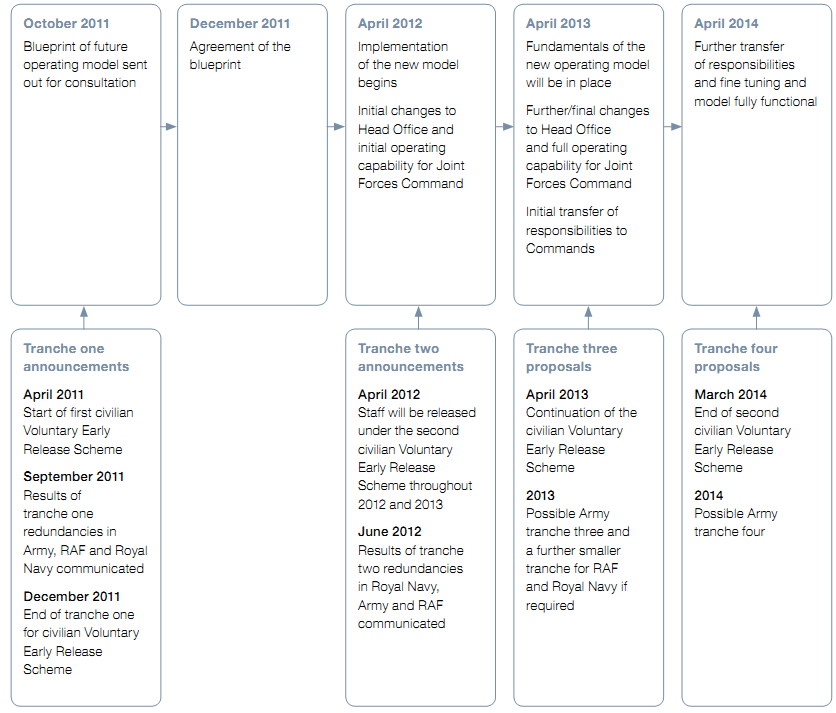
3.23 The Department sent out the initial model for consultation in September 2011, which was agreed by the Secretary of State in December 2011. The Department intends to start implementing the new operating model in April 2012, and is confident that the fundamentals will be in place by April 2013, with the new model fully functional by April 2014. However, this does not align with the timing of the military redundancy and Voluntary Early Release Scheme tranches, which will be well under way by 2013 with the RAF and Royal Navy redundancy tranches largely complete (Figure 10 overleaf) although the Department expects that these redundancies will mainly be made in line with reductions in capability rather than changes in the operating model. Given this timing, there is a risk that the Department will not have key skills needed under the new operating model, creating new skills gaps or worsen existing gaps. The Department has not determined how many personnel will leave in each business area, making it almost impossible to target redundancies to areas deemed less critical, although this does provide flexibility to target areas as the operating model develops.
Figure 10 Development of operating model against timings of redundancy tranches
Source: Blue print for the Department's new operating model, timeline for military redundancies, DIN for Civilian Voluntary Early Release |
3.24 Ideally, the Department would create a new operating model and then take decisions on the number of staff and skills required based on the model. However, it is under pressure to reduce costs early, to meet its spending review settlement, and delaying reducing headcount to match the model would risk cost reduction targets not being met. Pushing ahead with headcount reductions now may mean additional costs are incurred to re-recruit personnel with key skills.