How evaluation fits into the policy cycle
1.13 Evaluation is an integral part of a broad policy cycle that the Green Book formalises in the acronym ROAMEF. ROAMEF stands for Rationale, Objectives, Appraisal, Monitoring, Evaluation and Feedback. The ROAMEF cycle is presented in Chart 1.A. Though evaluation evidence can feed in throughout the whole policy cycle it is useful to highlight some of the key sections where evidence, including evaluation evidence can be used:
• appraisal occurs after the rationale and objectives of the policy have been formulated. The purpose is to identify the best way of delivering on the policy prior to implementation. It involves identifying a list of options which meet the stated objectives, and assessing these for the costs and benefits that they are likely to bring to UK society as a whole. The Green Book is the main source of guidance on appraisal;
• monitoring seeks to check progress against planned targets and can be defined as the formal reporting and evidencing that spend and outputs are successfully delivered and milestones met; and
• evaluation is the assessment of the policy effectiveness and efficiency during and after implementation. It seeks to measure outcomes and impacts in order to assess whether the anticipated benefits have been realised.
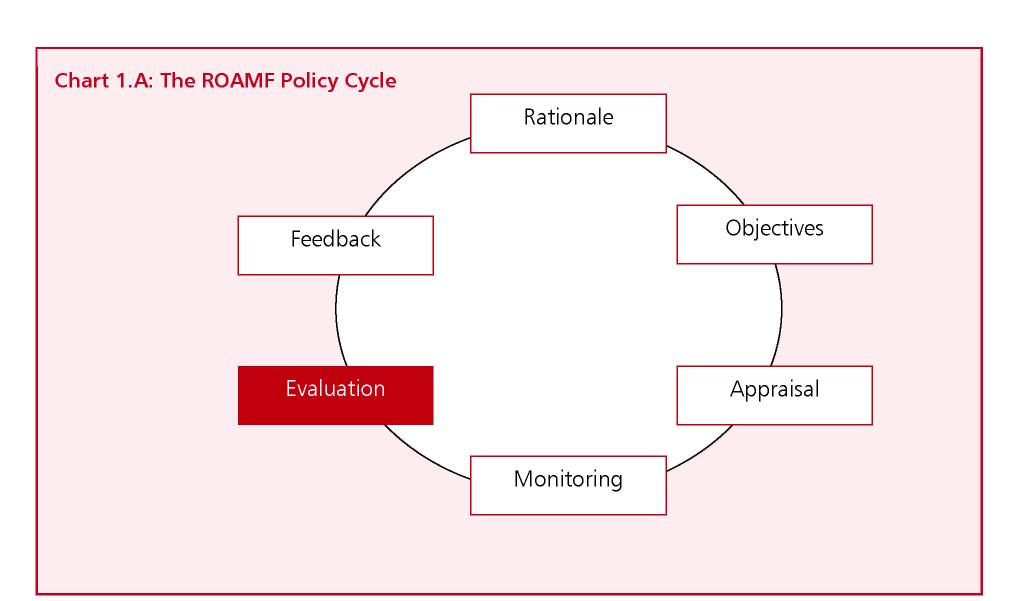
1.14 Chart 1.A suggests that these phases of the ROAMEF cycle occur in a stepwise fashion, but in practice this one-directional relationship rarely holds, the process is often iterative and there are significant interdependencies between the various elements. For example, data produced through monitoring activities are often used at the evaluation stage. In addition, evaluations can play a role in the policy development process - through, for instance, the use of pilots and trials - implying the presence of (potentially numerous) feedback loops at different stages of the cycle.
1.15 Therefore, whereas the simple ROAMEF policy cycle shows that an evaluation will take place after the policy has been implemented, evaluations can, in fact, occur at practically any other time. And importantly, decisions affecting and relating to any evaluation will almost always be taken much earlier in the policy process. Chapter 3 explains how what might seem minor aspects of the way a policy is formulated or implemented can have significant impacts upon the ability to evaluate it rigorously. It is important, therefore, to ensure that evaluation is considered and planned at the same time as the policy is being formulated so that these links can be recognised and accounted for.