Developing the Logic Model
5.5 A common method for setting out the policy objectives and intended outcomes is to develop a logic model (also known as "intervention logic" or "programme theory"). A logic model describes the theory, assumptions and evidence underlying the rationale for a policy. It does this by linking the intended outcomes (both short and long-term) with the policy inputs, activities, processes and theoretical assumptions.1
Box 5.A: Components of a Logic Model Kellogg Foundation Logic Model
Source: Kellogg Foundation (2004) |
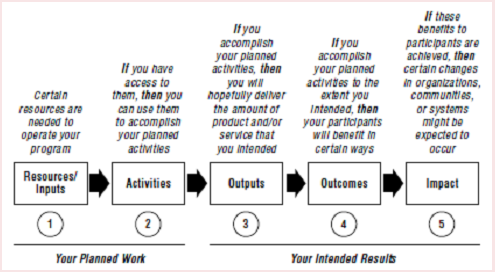
5.6 Generally, a logic model will identify the following elements of a policy intervention:
• the issues being addressed and the context within which the policy takes place;
• the inputs, i.e. the resources (money, time, people, skills) being invested;
• the activities which need to be undertaken to achieve the policy objectives;
• the initial outputs of the policy;
• the outcomes (i.e. short and medium-term results);
• the anticipated impacts (i.e. long-term results); and
• the assumptions made about how these elements link together which will enable the programme to successfully progress from one element to the next.
5.7 Setting out the intervention logic model can help to identify clearly the key inputs, and the expected activities, outputs, outcomes and impacts. This is important for a number of reasons, including:
• it can help to guide reviews and collection of existing evidence and data, thereby highlighting areas of deficiency which the evaluation might focus on. Methods for reviewing existing evidence are considered in Chapter 6;
• it can inform the evaluation objectives and development of the research questions;
• it can guide the design of data collection and monitoring processes, so that the right information is available for evaluating the intervention. Data collection is considered in more detail in Chapter 7;
• it can help to identify how the intervention could have unintended consequences, thereby further guiding data collection, the evaluation objectives and the evaluation framework. Unintended consequences are described further in Chapter 6; and
• it provides a transparent assessment framework within which existing evidence and the evaluation results can be combined to provide answers to the evaluation questions.
5.8 There are many ways to produce a logic model (and no necessarily right or wrong approach), but all generally include the elements listed above. Example logic models are described in Chapter 6.
_______________________________________________________________________
1 Logic Model Development Guide, WK Kellogg Foundation, 2004; The Department for Transport have published a 'Logic Mapping: Hint and Tips guide' as a practical resource to support the logic mapping process: Logic Mapping: Hints and Tips Guide, Tavistock Institute for Department for Transport, October 2010, http:/www.dft.gov.uk/