When are empirical approaches possible?
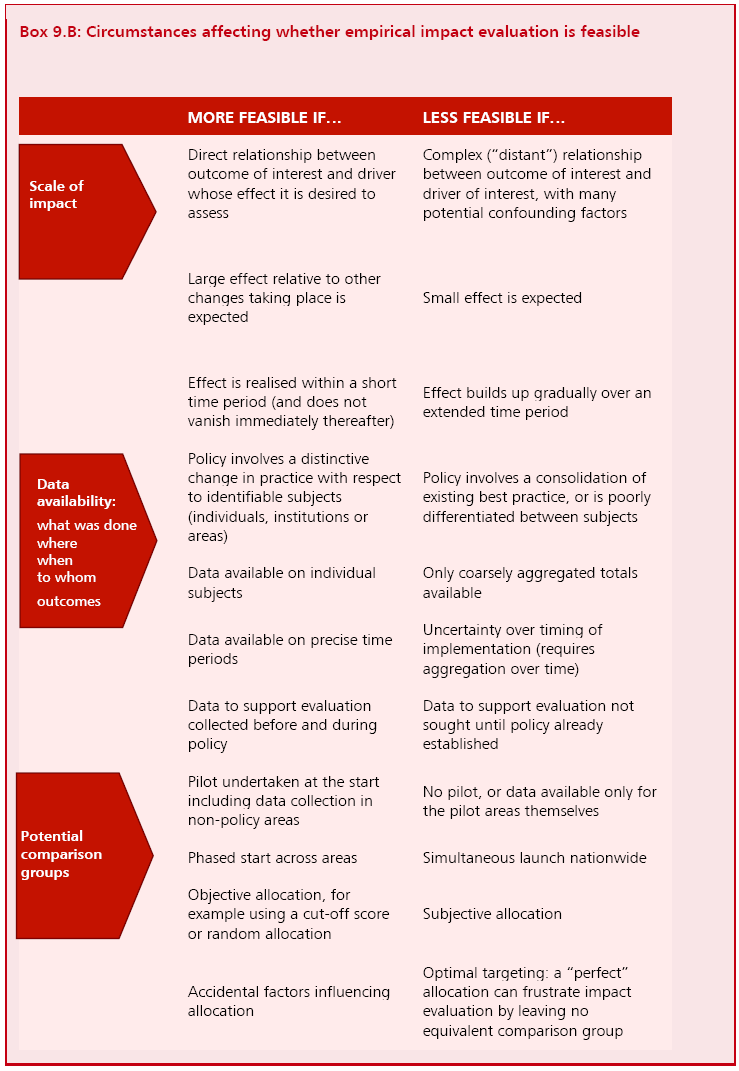
9.11 The requirements mentioned in the previous sub-section cannot be met for every policy, so quantitative impact evaluation is not always an option. It may therefore be necessary to manage expectations around policies for which impact evaluation is less feasible, particularly if the policy is small scale and the additional data collection required to evaluate it would be too difficult or expensive to undertake. Box 9.B summarises the features of policies that are likely to make empirical impact evaluation either more or less feasible. These features are discussed in more detail in the remainder of this chapter; their relative importance depends on the individual policy, so not every feature is necessary for every evaluation. It is important to note that cases cannot be separated simply into "possible" and "impossible", as set out below, there are finer gradations in between with some cases being more or less likely to yield valid results.
Box 9. B: Circumstances affecting whether empirical impact evalution is feasible