Departmental monitoring
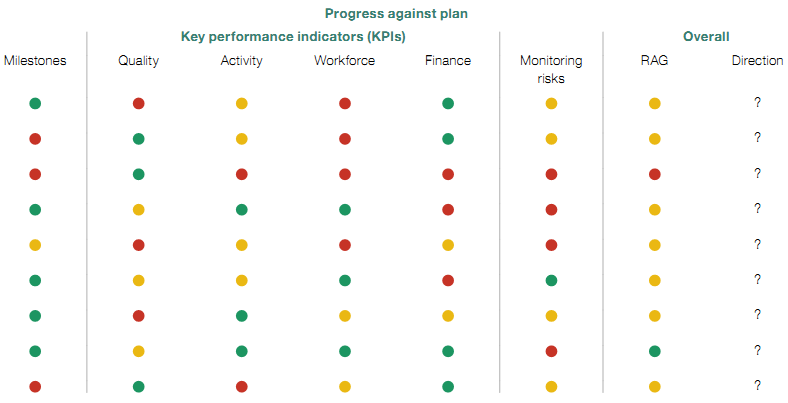
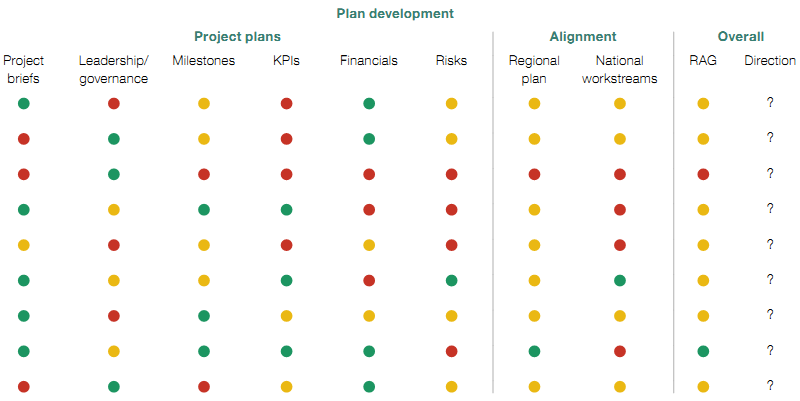
4.2 In 2010-11, the Department's QIPP Programme Management Office was responsible for monitoring QIPP planning. The Department provided strategic health authorities with a report card template, in August 2010, to support the move towards summary reporting as authorities' QIPP plans became more robust. The report card provides a high level summary of progress in plan development (if still underway) and of implementation progress against plan (Figure 12 overleaf).
4.3 The report card also provided details of their planned and actual savings, including an exception report on those that are not on track; potential best practice examples; and a risk management log. They were signed off by the responsible strategic health authority directors including the QIPP lead. Strategic health authorities submitted their report card on a monthly basis to the Department until March 2011. The Department established a system of red, amber, green ratings against which it assesses strategic health authorities' QIPP implementation plans (Figure 13 on page 30).
4.4 During 2010-11, the Department undertook a series of 'deep dives' into regional workstreams. This was to review alignment of QIPP plans, systems and process between the relevant strategic health authority, primary care trusts and providers and also to check that all parties understood what the QIPP savings represent. They identified best practice, which was then shared, and areas where further work, assistance, or guidance was needed.
_________________________________________________________________________________________________________________
Figure 12 Illustrative example of part of the report card template
NOTE
1 Each line represents the ratings for a regional workstream or a local health
economy, primary care trust or provider.
Source: Department of Health
_________________________________________________________________________________________________________________
4.5 The 'deep dives' were conducted at a mutually agreed time between the strategic health authority, the Department and primary care trusts and include representatives of clinical bodies and other providers to ensure that all communications regarding QIPP savings are understood by all. Examples of specific feedback points included opportunities to be paired up with other strategic health authorities in order to benefit from their planning and the need to include other stakeholder groups, such as GPs.
4.6 In 2011-12, as QIPP moved out of the planning phase and into the delivery phase, the Department moved from monitoring the production of plans into monitoring delivery. The NHS Operating Framework for 2011-12 set out the way that the Department will monitor progress in the NHS, including progress on implementation of QIPP. The overall monitoring of delivery in the Department is led by the Department's Performance Delivery Team, who work with strategic health authorities and the Department's policy teams to understand and performance manage progress.
_________________________________________________________________________________________________________________
_________________________________________________________________________________________________________________
4.7 Successful delivery of integrated plans, including QIPP, for 2011-12 aims to ensure that financial balance is achieved across the NHS with quality of care being maintained or improved. The headline measures on quality, resources and reform set out in the NHS Operating Framework for 2011-12 cover:
● key quality measures for issues such as waiting times, healthcare associated infections, mixed sex accommodation and patient experience;
● resource indicators such as activity levels, which help the NHS to understand how they can build a sustainable service; and
● key areas of reform, such as progress on the foundation trust pipeline and the development of clinical commissioning groups.
_________________________________________________________________________________________________________
Figure 13 Implementation plans - criteria for a green rating
| Project briefs |
|
| |
| Has a summary project brief been completed? |
| The project brief has been completed (in the suggested template format or equivalent) and contains sufficient detail on all areas and can be used as a robust foundation for project initiation/delivery. | |
| Leadership/ governance | |||
| Leadership identified |
| Project sponsor/project leadership identified. | |
|
|
| Project manager identified and has appropriate capacity to deliver. | |
| Clear governance |
| Clear project governance outlined. | |
|
|
| Clinical engagement has been considered and in place where appropriate. | |
|
|
| Appropriate sector/cluster/local health economy engagement has been considered and in place where appropriate. | |
| Milestones | |||
| Appropriate milestones identified |
| Project milestones have been identified with named owners for delivery. Milestones are appropriate, detailed and of sufficient quality. | |
| Progress against milestones |
| Milestone identified are being hit at the appropriate rate and time. Milestone status is up to date and marked when completed. | |
| Key performance indicators (KPIs) | |||
| Appropriate KPIs identified |
| Quality, activity, workforce KPIs have been considered and appropriately identified. Appropriate benchmarks or targets set against which performance can be measured. | |
| Progress against KPIs |
| KPIs identified are being hit at the appropriate rate and time. KPI status is up to date and marked when completed. | |
| Financials | |||
| Financial estimate |
| Financial estimates have been calculated and are based on appropriate assumptions. Costs associated with the project have been adequately considered, calculated and included where appropriate. Assumptions have been detailed. | |
| Financial phasing |
| Appropriate phasing of financial savings detailed (e.g. monthly). | |
| Financial progress |
| Actual against planned financials on track. Planned variance against actuals less than 5 per cent. Financial tracking has been updated to reflect the latest actuals. Any changes required to the forecast due to project changes are appropriately updated. | |
| Risks | |||
| Risk identification |
| Risk register fully developed, mitigation and owner outlined. | |
| Risk management |
| Actions being taken to fully mitigate/manage the identified risks. | |
Source: Department of Health
_________________________________________________________________________________________________________
4.8 The Department's monitoring of efficiencies will focus on several key areas, including those savings which are driven by changes in demand, and those which are cash releasing. Monitoring will also assess the reinvestment of these savings.
4.9 Progress against the comprehensive set of indicators in the NHS Operating Framework for 2011-12 will be regularly published in the Quarter13, ensuring an account of progress is publicly available. The Department will hold the NHS to account across this range of indicators.
4.10 There are some areas of QIPP where cost savings or quality improvements will not be apparent until substantial transformational change programmes have taken place locally. As part of the 2011-12 planning process, the Department has been working with strategic health authorities to agree milestones for the transformational change elements of their plans, which will then be used to support monitoring of progress on building the foundations for QIPP and reform.
______________________________________________________________________________________________________________
13 A quarterly departmental publication that provides a summary of the NHS financial position and performance against the national priorities set out in the NHS Operating Framework.