Principles of local incentives and empowerment
5.6 The local incentives and empowerment workstrand seeks to create the environment where collaboration and innovation on the frontline can flourish. The work has therefore adhered to two key principles to guide its analysis and recommendations:
• encourage the good: By identifying successful or promising initiatives and reforms to delivery systems that can be extended further, rather than creating new programmes or imposing rigid solutions which are neither locally owned nor appropriate for the challenges they seek to address; and
• eliminate the barriers: By reducing bureaucratic burdens on the frontline and stopping programmes that do not add value to create space for those that do.
5.7 This approach complements that of the other Operational Efficiency Programme workstrands. These aim to stimulate better value for money across discrete areas of spend that, traditionally, the private and public sectors have seen as ripe for greater efficiency such as greater standardisation of costs in back office functions and better asset management. By drawing on the professional operational capacity in government, local managers can be freed to concentrate on delivering high-quality services to the citizen. This needs to be complemented with a direction of travel that gives more space and incentives for local innovation and concerted local action, supports innovators and involves frontline staff and their clients in redesigning public services. This workstrand sets out recommendations to support that approach.
5.8 Figure 5.A sets out the framework used to structure the analysis.
| Figure 5.A: Local incentives and empowerment: framework
|
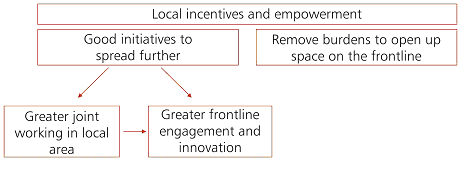
5.9 The workstrand has firstly looked at how to encourage greater joint working across public services at the local level, to allow for more effective, customer centred and efficient services. An analysis of potential benefits and recommendations for driving forward this area-based approach are at paragraphs 5.13-5.28.
5.10 This kind of area-based approach will often involve a re-examination of the way that services are designed and some of the best ideas on how to improve efficiency and effectiveness of services come from the frontline. Accordingly, the workstrand has also focused on programmes that prioritise engagement with frontline public service professionals to identify innovative approaches, redesign services with a focus on the customer, improve outcomes and increase efficiency. For example, the use of Lean in selected Job Centre Plus sites, with frontline engagement core to its approach, has delivered 15 to 30 per cent efficiency savings,3 much improved service quality and greater staff satisfaction. Recommendations on this area are at paragraphs 5.29-5.40.
5.11 Vital to creating the space for joint working, frontline engagement and innovation, is an active approach to removing barriers that frustrate individuals, teams and organisations. For example, Sir Ronnie Flanagan's Independent Review of Policing found that reducing the amount of non-essential information being captured would free up approximately 40,000 hours per year in a medium sized force.4 The review found that only a proportion of bureaucracy was imposed by the Home Office and that some of it was 'self imposed' by senior and middle-ranking officers and others in the chain of command locally. The Government will continue to pursue opportunities to reduce these types of burdens on the public sector. Recommendations on how this might be given new momentum are at paragraphs 5.41-5.46.
5.12 Finally, the capability and capacity to create a culture of innovation and collaboration needs to be developed throughout the public sector. Recommendations on how to take this forward are at paragraphs 5.47-5.51.
_______________________________________________________________________________________
3 Innovation across central government, NAO, 2009.
4 Independent Review of Policing, Sir Ronnie Flanagan, February 2008.